
Why shop products and home remedies do not work
Almost everyone who contacts us has tried to deal with it themselves first. That is entirely normal, and it is worth understanding why those attempts usually fail, because some of them make the problem harder to solve afterwards.
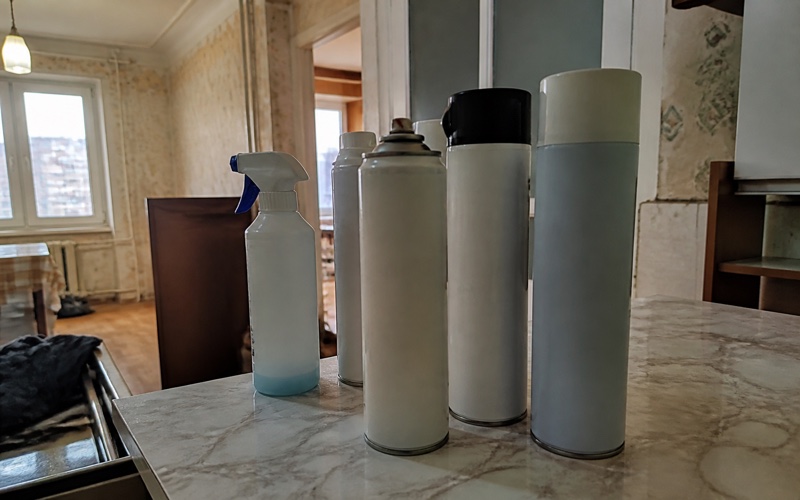
Three reasons aerosols do not solve it
- 1
They do not reach the harbourages
Insects live in gaps, mattress seams, behind skirting boards and inside furniture joints. An aerosol kills what it directly hits, which is typically 5-10% of the population.
- 2
They do not affect eggs
Even perfectly executed spraying leaves the eggs untouched. After 7-14 days a new generation hatches and you are back where you started.
- 3
They have no residual action
A shop aerosol loses activity within hours. A professional product stays active for 4-6 weeks and kills exactly that newly hatched generation as it emerges.
Those three together explain why the pattern is so consistent: it looks like it worked for a fortnight, then it did not.
Resistance is a real problem
Part of the bedbug and cockroach populations have developed resistance to pyrethroids, which are the basis of most widely available shop products. These substances have been in use for decades, and the more tolerant individuals survive and breed.
In practice that means an aerosol which worked ten years ago may do essentially nothing against the particular population in your building today. Professional work handles this by rotating active substances and combining methods, and by using non-repellent actives that insects cannot detect and therefore do not avoid.
This also explains a frustrating pattern people report: the spray seems to make the insects run rather than die. That is a repellent effect on a resistant population, which is close to the worst possible outcome.
When DIY makes the situation worse
- Cockroaches. Spraying aerosols scatters the colony: the insects flee deeper into the structure and into neighbouring flats. The problem becomes larger and harder to solve than it was.
- Ants. Spraying a trail can cause colony budding — one nest becomes several.
- Bedbugs. Spraying pushes them into adjoining rooms and furniture. Worse still is moving the bed to another room: bedbugs follow the person and colonise the new sleeping place while the population in the old one survives.
- For any pest: spraying in the days before a professional treatment makes that treatment less effective.
Home remedies: what they actually do
Vinegar, lavender, essential oils, cedar, chalk — these mostly act as repellents. They deter insects from a specific spot but do not kill them and have no effect on eggs.
The practical consequence is that the insects move somewhere else in the same property, and the occupant concludes the problem is being solved. In reality the population survives and continues to grow, usually somewhere less convenient to find.
Steam kills on contact and is genuinely useful, but only where the steam physically reaches. It does not get into deep gaps or inside a mattress, which is exactly where bedbugs are.
Diatomaceous earth does work by physical abrasion, but slowly, only where it stays dry, and only where insects walk through it. It is a supplement to a treatment, not a substitute for one.
What genuinely does help
Not everything is pointless. These actions really do reduce the problem and are useful both before and after a professional treatment:
- Washing at 60 °C — reliably kills bedbugs, fleas and moths in textiles, including eggs. This is the single most effective home method there is.
- Thorough vacuuming — physically removes part of the population and its eggs. The bag goes straight into a bin outside the flat.
- Removing the source — throwing out infested food, cleaning the drain trap, eliminating standing water. In many cases this is the decisive step.
- Sealing gaps and fixing damp — prevents insects coming back in from the stairwell or a neighbour.
- Freezing — for items that cannot be washed; several days in the freezer, sealed in a bag.
When DIY is actually enough
Honestly: not every case needs a professional, and we do not think a service should be sold where someone can handle it themselves.
- A few fruit flies around the fruit bowl. Remove the source, clean the drain trap, done.
- Pantry moths found in one packet, early. Throw out the packet, empty and wipe the cupboard, move everything into airtight containers.
- Autumn invaders. Ladybirds, shield bugs and similar species that come inside in October looking for somewhere to overwinter. They do not breed indoors and they disappear on their own. Collect them and seal the window gaps.
- A single wasp in the room. Open the window. A nest is a different matter — from €60.
The dividing line is whether the insects are breeding in the property. If they are, DIY buys time and rarely more. If they are not, you probably do not need us, and we will say so.
Book a pest control visit
Fill in the form — we reply within 5 minutes. We work weekends and handle urgent callouts.