
Flea treatment in Riga
Fleas are jumping blood feeders that usually arrive with a pet, but they also come in from the cellar, the stairwell or from previous tenants. The adults you can see are only a small part of the problem - most of the population is eggs and larvae sitting in textiles.
How to spot it
Bites around the ankles
Fleas jump from the floor, so bites cluster on feet, ankles and lower legs - unlike bedbugs, which bite exposed skin in bed.
A restless pet
Increased scratching, chewed and over-licked patches, general agitation.
Black specks in the fur
Flea droppings look like black grains; on a damp tissue they leave a reddish smear, which is digested blood.
Jumping from the carpet
Walking across a carpet, or entering a flat that has stood empty, brings tiny insects leaping onto your legs.
Pale larvae in floor gaps
Small whitish larvae in carpet pile, floor cracks and the pet's bedding.
Why treating the animal alone never works
The adult fleas on a pet are roughly five per cent of the total population. The other ninety-five per cent - eggs, larvae and pupae - are in the environment: in carpets, in the seams of soft furniture, in skirting board gaps and in the animal's bed.
So if you treat only the animal, fleas return from the environment within days. And the reverse is equally true: treat only the rooms, and the animal reintroduces them immediately.
Only doing both at once works: a professional treatment of the premises and, in parallel, treatment of the animal with a product recommended by your vet. We do not treat animals - that is veterinary work - and we say so before booking so nobody is surprised. More in pest control with pets.
Why the pupae are the difficult part
The flea pupa sits inside a sticky cocoon that collects dust and fibres. Insecticides essentially cannot penetrate it, and the pupa can wait for the right moment for weeks or months.
What triggers emergence is vibration, warmth and carbon dioxide - in other words, the presence of a person or an animal. That is exactly why fleas attack in a wave when you walk into a flat that has stood empty for a while, and why a holiday home can seem clear until the day you arrive.
The practical consequence is unusual but important: after the treatment you should walk around the rooms more than usual and vacuum regularly. The vibration provokes the pupae into hatching, and the new fleas step straight into the treated residual layer. Doing nothing for two weeks actually slows the result down.
Where the treatment is applied
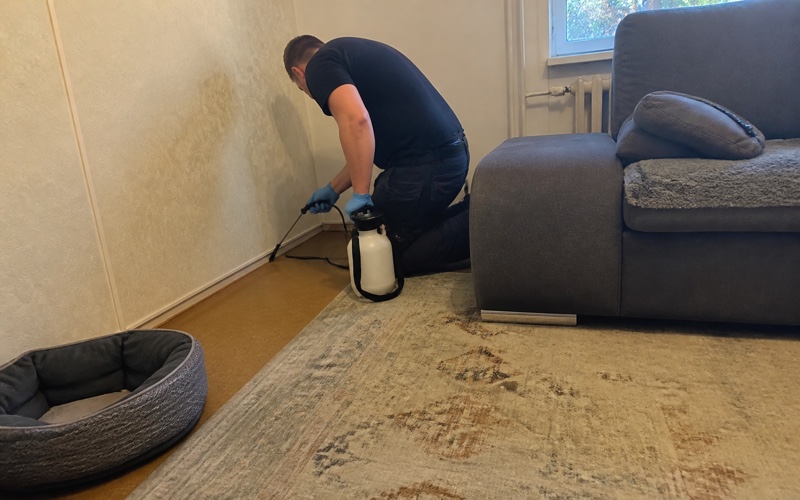
Fleas do not jump much higher than about one metre, so the treatment concentrates on the floor zone: skirting boards, carpets, the undersides and seams of soft furniture, the animal's bed and the area around it, and the gaps between floorboards.
We use products with a long residual action. Insect growth regulators may be added: these prevent larvae from developing into adults and break the breeding cycle, which matters because the larval stage is where most of the population sits.
Before we arrive it helps a great deal to wash the pet bedding and other textiles at 60 degrees and to vacuum all floors and soft furniture thoroughly, throwing the bag out of the flat straight away.
Fleas in a flat with no pet
This is a common and genuinely puzzling situation for people who have just moved in. Fleas do not need your animal - they need any warm-blooded animal, and there are several ways they arrive.
- Left by previous occupants. Pupae survive an empty flat for months and hatch when someone moves in. This is the classic case in pests after moving in.
- From the cellar or stairwell. Stray cats sheltering in a basement or entrance hall leave a population behind them.
- Carried in on clothing after visiting a home or a yard where animals live.
- From a neighbouring flat along the same routes other insects use.
In these cases the treatment is the same, but there is no parallel veterinary step, and the result is usually quicker.
What to expect after the treatment
Adult fleas die within a few days. Because new ones keep emerging from the pupae, a complete result normally takes two to four weeks, and it is normal to see a handful of fleas during that window.
- Keep vacuuming every day or two for the first fortnight, and empty the vacuum outside the flat each time.
- Do not wash the skirting boards or the treated floor edges for two to four weeks - that is the layer doing the work.
- Keep the animal's treatment going according to your vet's schedule, not just once.
- Do not shampoo the carpets immediately after treatment; wait until the residual period is over.
If fleas are still appearing in numbers after a month, tell us - it usually means either a second untreated source or an animal that has been reinfested. See after treatment.
What flea bites look like
Flea bites are small, hard, red spots with a darker centre, usually in loose groups of two or three on the lower legs and ankles. They itch intensely and often more sharply than bedbug bites.
The distinguishing feature is the location. Bedbugs bite exposed skin while you are lying down - shoulders, arms, neck. Fleas bite where they land, which is the bottom half of the body. If you are unsure, our page on flea bites compares them side by side, and insect bites covers the wider picture.
How fleas get into a Riga flat
Understanding the route in usually explains how bad the problem will be and how quickly it can be cleared.
- On a cat or dog after a walk or after contact with another animal. This is the most common route and the easiest to break, provided the veterinary treatment is kept up.
- From the stairwell or cellar. Stray cats sheltering in a basement or entrance hall are a standing source in older blocks, and the fleas travel up through the stairwell.
- From a neighbouring flat along the same gaps and pipe runs other insects use.
- Left behind by previous occupants. Pupae survive an empty flat for months, which is why a newly rented flat can produce a wave of fleas on the first day.
- On clothing and bags after visiting a home or yard where animals live.
Where the source is the shared parts of a building, treating one flat repeatedly is expensive and frustrating. In that case it is worth raising it with the building manager (apsaimniekotajs), because the cellar and stairwell need treating too.
Book a pest control visit
Fill in the form — we reply within 5 minutes. We work weekends and handle urgent callouts.