
Ant control in Riga
The ants you see on the kitchen worktop are only foragers - about five to ten per cent of the colony. Kill those and the nest is untouched, and within days it simply sends out more.
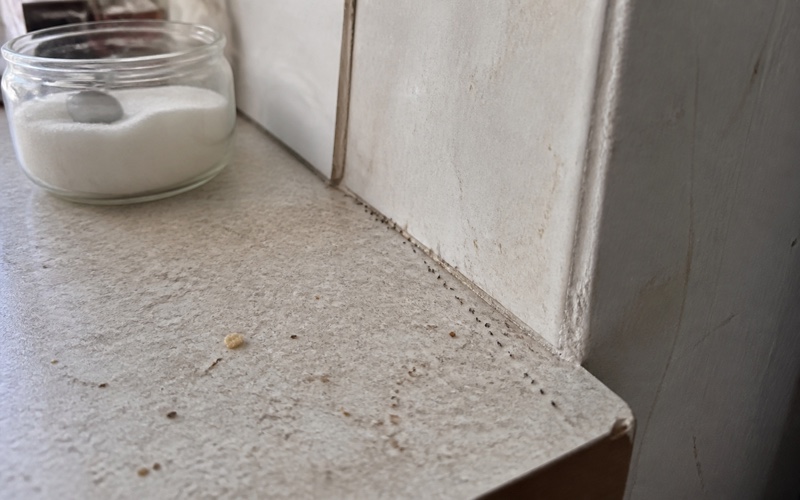
How to spot it
An ant trail
Ants follow a pheromone trail in an even line along a skirting board, a wall edge or a worktop.
Ants around food
Especially around sweet things, sugar, honey and damp food.
Small piles of sand
At nest exits - in paving joints, decking gaps and near skirting boards.
Winged ants
Winged ants appearing in spring and summer mean the colony has matured and is reproducing.
Ants in the bathroom
Some species follow moisture rather than food, and appear around the bath, sink and pipe runs.
Why bait works better than spraying
If you kill ants on sight or spray the trails, the colony reacts in exactly the wrong way: it stops using that route, splits, and often establishes several new sub-nests. The problem gets wider rather than smaller.
The bait method uses the colony's social structure instead. A forager carries the bait back to the nest and feeds it to the others, including the queen and the brood. The effect is slower - in the first few days you may even see more ants, because they are actively carrying bait - but it destroys the colony rather than the visible workers.
Important: while the bait is working, do not spray or wash the ant trails with cleaning products. That breaks the chain that carries the bait to the nest and can undo the whole treatment.
Pharaoh ants - a case of their own
Pharaoh ants are tiny (about 2 mm) and yellowish-brown, and they are one of the hardest species to eliminate in blocks of flats. They nest in wall cavities, near heating pipes and inside floor structures, where they simply cannot be reached physically.
For this species spraying is especially damaging: the colony fragments - a process known as budding - and one nest becomes several. It is the classic way a manageable problem becomes a building-wide one.
The only effective approach is specialised bait and, where possible, treating several flats at the same time. In practice this is arranged through the building manager (apsaimniekotajs), and it is worth pushing for: see pest control for property managers.
Ants in a house
In a detached house the nest is usually outside - under decking, under paving, near the foundations or in a tree stump - and the ants only come indoors to forage. In that case we treat both the entry routes and the nest itself, and carry out a perimeter treatment around the building.
Finding the nest is worth a little patience. Follow the trail outwards rather than inwards: the foragers heading home with food move in a purposeful straight line, and they will take you to the entrance. Small piles of excavated sand in paving joints are the other reliable clue.
See pest control in a house and summer houses.
Why ants come indoors in the first place
Ants forage for two things: sugars and protein, with the balance shifting through the season. Early in the year colonies want protein for the developing brood; by late summer the demand switches heavily to sugar, which is when kitchens suddenly become interesting.
- Accessible food. Sugar, honey, jam, open fruit, pet food left down, crumbs in cupboard corners.
- Moisture. Leaking pipework and condensation attract several species regardless of food.
- Easy entry. Gaps around window frames, unsealed pipe runs, balcony door thresholds, cracks in the foundation.
- Shelter. A warm building is attractive in a wet spring or a dry summer when outdoor conditions are poor.
Removing the food and sealing the obvious entry points will not clear an established colony, but it makes the bait far more attractive by comparison, which measurably speeds the result.
How the treatment is carried out
The work follows a fixed order, and most of the time is spent on the first step rather than the last.
- 1
Inspection.
We follow the trails to establish where the ants enter and, if possible, where the nest sits.
- 2
Species identification.
Pharaoh ants, garden ants and moisture-seeking species need different baits, so this determines the product.
- 3
Bait placement.
Bait is applied in small dots along the active trails and near the entry points, out of reach of children and pets.
- 4
Entry route treatment.
Where relevant we treat thresholds, pipe penetrations and the outside perimeter.
- 5
Follow-up.
For a large or split colony a second visit after two to three weeks refreshes the bait.
The whole point is patience: an ant treatment that looks dramatic on day one has usually done the wrong thing.
Which ants you actually get indoors
Three groups cover almost every callout in Riga, and they behave differently enough to matter.
- Black garden ants. The common outdoor species, nesting under paving, decking and near foundations, and coming indoors to forage for sugar. The nest is outside, so the fix combines bait indoors with treatment of the nest and perimeter.
- Pharaoh ants. Tiny, yellowish, and living permanently inside the building fabric. These are the difficult ones, and spraying makes them worse.
- Moisture-seeking species. Ants that appear around a bathroom or a leaking pipe rather than around food. Here the leak is the real problem and the ants are the symptom.
Identification is not academic: the bait that clears a garden ant trail in a week can be ignored entirely by a pharaoh ant colony, which is why we establish the species before choosing a product.
What to expect after the treatment
The pattern is consistent, and knowing it prevents people from undoing the work.
- Days one to three: activity often increases as foragers recruit to the bait. This is the treatment working, not failing.
- Days four to ten: numbers fall noticeably as the bait reaches the brood and the queen. Trails become patchy and then stop.
- Weeks two to three: occasional stragglers from a satellite nest. If activity is still substantial at three weeks, tell us - it usually means a second nest or a species that needs a different bait.
Throughout, the rule is the same: leave the bait spots and the trails alone, and do not spray anything. See after treatment.
Prices and what a visit involves
An ant treatment in a flat is from 55 euros for one room, 60 euros for two rooms and 65 euros for three. A house is from 120 euros, and where a second visit is needed a repeat treatment is from 60 euros. Commercial premises are quoted after a survey.
A typical visit takes 45 minutes to an hour and a half. Most of that is inspection - following the trails, finding the entry points and, for a house, walking the outside perimeter. The bait placement itself is quick.
You do not need to empty the kitchen cupboards or move out. What helps is clearing accessible food, wiping crumbs from the worktop, and leaving the trails visible so we can see where the ants are actually running. See how to prepare and prices.
Book a pest control visit
Fill in the form — we reply within 5 minutes. We work weekends and handle urgent callouts.