
Pest control in a house
In a house, insects almost always come in from outside, so the treatment is not just a question of rooms. Without work on the entry routes and the building perimeter, the same problem returns every season.
Why the perimeter matters more than the rooms
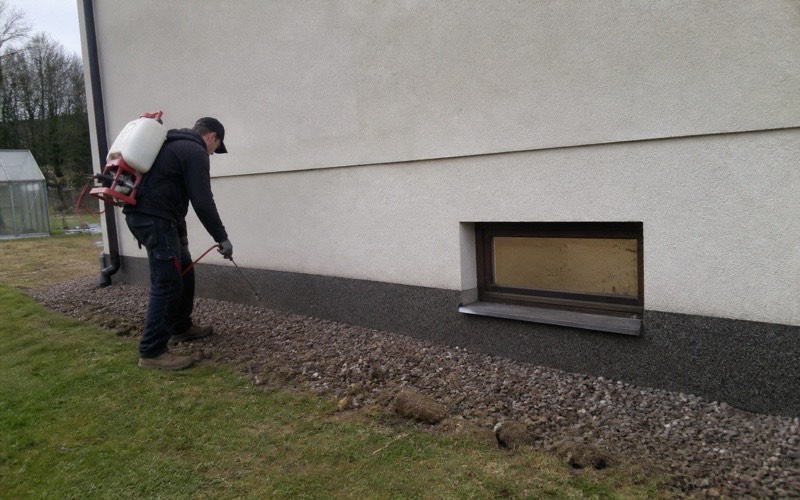
Unlike a flat, a house is in direct contact with the ground and the surrounding vegetation along its whole perimeter. Ants come in from a nest in the garden, spiders and earwigs from leaf litter piled against the wall, wasps from a nest under the eaves.
So the treatment covers the building envelope as well as the rooms: gaps in the foundations, the plinth, door and window reveals, ventilation openings and the gaps between decking boards.
Often the biggest single improvement is physical rather than chemical: moving the log pile a metre away from the wall, clearing leaf litter, sorting out the downpipes so rainwater does not collect against the foundations, and sealing gaps around pipe entries.
Basement and loft
These are the two areas the household visits least, which is exactly why problems develop there unnoticed for months.
In the basement the driving factor is damp: it attracts silverfish, earwigs and spiders. In the loft the typical problems are wasp nests and woodworm in the timber.
If you find small round holes in the beams or boarding with pale wood dust beneath them, that is a separate job with its own approach — see woodworm treatment.
Which zones get treated
- Living areas. Typically bedbugs, ants, flies and gnats.
- Kitchen. Ants, pantry moths, occasionally cockroaches.
- Basement. Silverfish, spiders and earwigs, because of the damp.
- Loft. Wasp nests and woodworm in structural timber.
- Garage and outbuildings. Spiders, wasps, assorted beetles.
- Building perimeter. The entry route for everything above.
- Grounds. Separate treatments against mosquitoes and ticks.
It helps to say in the enquiry which zones you have seen activity in. That lets us judge the scope and the price far more accurately before we arrive.
Prevention that actually works
In a house the physical changes around the building do more than any repeat treatment.
- Firewood. Keep the stack at least a metre from the wall and raised off the ground.
- Leaf litter and compost. Move fallen leaves, branch piles and compost away from the walls.
- Drainage. Keep downpipes working so rainwater does not pool at the foundations.
- Sealing. Fill gaps in the foundations, around pipe entries and in window reveals.
- Screens. Fit or repair mesh on ventilation openings and windows.
- Loft ventilation. Woodworm develops far more slowly in dry timber.
Larger area, different pricing logic
Treating a house usually covers more area and more distinct zones than a flat: living rooms, basement, loft, garage, utility rooms and the building perimeter.
That is why the price starts from €120 and is confirmed after we know the area and the number of zones. A repeat treatment, where one is needed, is from €60, and a wasp nest from €60. See prices.
How the visit runs
A house takes longer than a flat, mostly because there are more separate zones and an outdoor perimeter to cover.
- 1
Survey.
We walk the property with you, indoors and out, and identify the species, the harbourage and the entry routes. This is also where we agree what stays untreated.
- 2
Preparation.
You clear access to walls, skirting boards, the basement and the loft. We tell you which rooms need what, room by room.
- 3
Indoor treatment.
Applied to specific harbourage points rather than sprayed across the rooms — gaps, skirting boards, behind furniture, pipe runs.
- 4
Perimeter treatment.
The plinth, foundation gaps, door and window reveals, ventilation openings and the ground immediately against the wall.
- 5
Airing and handover.
For a chemical treatment, 2 to 4 hours out of the treated rooms, then thorough airing. We go through what to expect over the following weeks.
Where only the basement or the perimeter is being treated, you can usually stay in the house throughout. Tell us in advance if anyone in the household has asthma, an allergy or a respiratory condition, and we adjust the method and extend the airing period rather than discovering it afterwards.
Book a pest control visit
Fill in the form — we reply within 5 minutes. We work weekends and handle urgent callouts.