
Mosquito control outdoors and indoors
Mosquitoes cannot be eliminated from an open area, but their numbers in a defined zone can be cut substantially for several weeks - by treating the places they rest and removing the standing water where larvae develop.
How to spot it
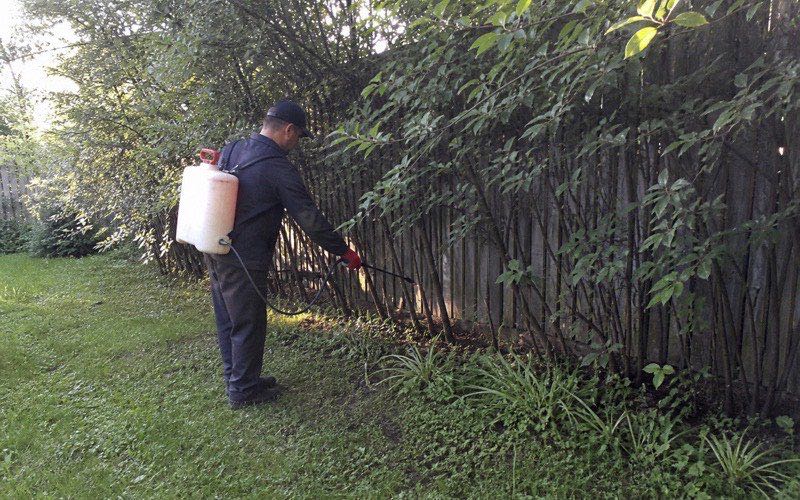
Mosquitoes in shady shrubs
During the day they shelter in shaded, damp vegetation - which is exactly where the treatment goes.
Activity at dawn and dusk
Peak activity is at dusk and early morning, in still air with little wind.
Standing water nearby
Butts, buckets, tyres, blocked gutters and pond edges are where larvae develop.
Mosquitoes indoors
Usually coming in through unscreened windows or ventilation; occasionally breeding in a damp cellar.
Bites through thin clothing
A sign of high numbers rather than a different species.
How the numbers are reduced
The treatment rests on two principles. First, a barrier treatment: the product is applied to the vegetation where mosquitoes rest during the day - the undersides of shrub leaves, hedges, shaded walls, the base of fences. Mosquitoes landing on the treated surface die, and the effect lasts several weeks.
Second, removing larval development sites. Mosquito larvae develop in standing water, and a very small volume is enough: a water butt, a forgotten bucket, plant pot saucers, tyres, a blocked roof gutter.
If the standing water is not dealt with, new mosquitoes keep developing in the same place and the effect of the treatment is much shorter.
When treatment makes sense
Treatment is effective over a defined, limited area: a garden, a terrace, a seating area, an event venue, the grounds of a guest house. It will not make mosquitoes non-existent - they remain in neighbouring plots and in natural wetland.
This matters particularly around Riga, where large areas border on marshland, the Daugava floodplain and the pine woods towards Jurmala. In those locations a barrier treatment makes a garden usable in the evening; it does not create a mosquito-free zone, and we would rather say so before you book.
If the treatment is for a specific event, it is best carried out one to two days beforehand so the product settles onto the vegetation.
The season in Latvia
The season runs roughly from May to September, peaking in June and July. The first generation emerges from meltwater pools in spring, which is why a wet April is usually followed by a heavy early summer.
A second, often worse wave follows heavy summer rain, because every container and hollow that fills becomes a breeding site for a week or two. In practice this means one treatment early in the season and a second in July covers most gardens. See the seasonal guide.
Mosquitoes indoors
Indoors the picture is different. Mosquitoes very rarely breed inside a flat - they fly in through open windows, balcony doors and ventilation openings, and the practical answer is mechanical rather than chemical.
- Insect mesh on opening windows and balcony doors is the single most effective measure.
- Mesh over ventilation grilles, particularly in older blocks where the shaft connects to a damp cellar.
- Check the cellar if mosquitoes appear in winter - standing water in a basement can sustain a population all year.
An honest limit: if you live on a low floor next to a wet green area, mosquitoes will keep flying in from next door regardless of what we treat inside your flat.
Removing the breeding water
This is the part of the job that decides how long the treatment lasts, and most of it is not chemical at all. A mosquito needs remarkably little standing water - a bottle cap holds enough for a few larvae, and a forgotten bucket can produce hundreds.
- Water butts - cover with a fine mesh lid, which still lets rain in.
- Plant pot saucers - empty them, or fill them with gravel so water does not stand.
- Blocked gutters and downpipes - a clogged gutter is one of the most productive sites on a house and one of the least often checked.
- Tyres, buckets, wheelbarrows and toys left out in the garden.
- Tarpaulins and pool covers, where water pools in the folds.
- Ornamental ponds - fish or a small pump will handle it, since larvae need still water.
Doing a circuit of the plot after rain, once, and fixing what you find is worth more than an extra treatment.
What you can do alongside treatment
Barrier treatment works best combined with a few simple physical measures, particularly on a terrace or seating area.
- Keep grass short and cut back dense shrubbery around seating - mosquitoes rest in exactly that vegetation during the day.
- Use a fan on a terrace. Mosquitoes are weak fliers and a moving airflow keeps them off far more effectively than most repellent devices.
- Fit insect mesh on windows and balcony doors before the season starts.
- Improve drainage in permanently boggy corners of the plot.
What does not work reliably, despite the marketing: ultrasonic devices, and citronella candles beyond a very short radius in still air.
Book a pest control visit
Fill in the form — we reply within 5 minutes. We work weekends and handle urgent callouts.