
Cockroach control in Riga
Cockroaches breed extremely fast and move between flats through ventilation shafts and service ducts. The insects you see are only a small part of the colony - the rest are hidden in cracks and behind appliances.
How to spot it
Insects in the kitchen at night
Switch the light on at night and they scatter. Cockroaches seen in daylight usually mean the population is already large.
Black speckled marks
Droppings look like ground pepper on cupboard surfaces, behind the fridge and in cupboard corners.
Egg cases (oothecae)
Brown, capsule-shaped egg packets 6-9 mm long, tucked into cracks and behind furniture. Each holds 30-40 eggs.
A distinctive smell
A large colony produces an unpleasant, sweetish, musty odour.
Shed skins
Pale, empty casings - cockroaches grow by shedding their outer shell.
Where cockroaches hide
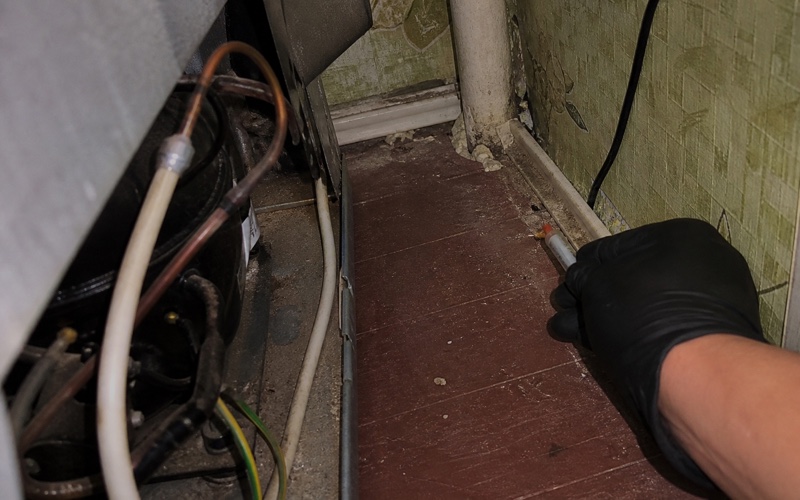
Cockroaches need warmth, moisture and food, so the centre of an infestation is almost always the kitchen or bathroom. Typical harbourages: behind and underneath the fridge (motor heat), behind the cooker, under the sink, in cupboard corners and joints, around water and waste pipes, and inside the casing of a microwave or other appliance.
In a block of flats they move freely between apartments through ventilation and pipe shafts. This is why a flat often fills with cockroaches shortly after the neighbour has had a treatment - the colony simply relocates. In older Riga blocks the shaft usually runs vertically through the whole stack, which is why the flats directly above and below yours matter more than the ones on either side.
Why they multiply so fast
The species behind almost every domestic problem in Latvia is the German cockroach (Blattella germanica) - 10-15 mm long, light brown, with two dark stripes on the shield behind the head.
The female carries her eggs in a capsule called an ootheca, holding 30-40 eggs. The critical detail is that she carries it with her almost until the moment of hatching, so a treatment that kills adults often misses the eggs entirely - they are protected and only drop into a crack at the last moment.
From egg to adult takes six to twelve weeks, and a single female produces four to eight oothecae in her lifetime. A handful of insects brought in on a delivery box can become a colony of several hundred within six months.
They are also nocturnal and hide by day. Seeing them in daylight normally means the population has grown so dense that there is no longer room in the harbourages.
Why gel bait beats spraying
Spraying aerosols kills the visible insects but scatters the colony: the survivors move deeper into the structure and into neighbouring flats. Very often the problem afterwards is the same size or larger.
Gel bait works the opposite way round. The product is applied as small dots near the harbourages. A cockroach eats the bait and returns to the harbourage, where the active ingredient passes to the rest of the colony through droppings and through the body of the dead insect - reaching individuals that never touched the bait themselves. This is called the cascade effect.
The practical advantage: during a gel treatment you do not have to move out and you do not have to empty the cupboards. More detail on the gel baits page.
Why cockroaches are a health issue, not just unpleasant
Cockroaches essentially do not attack people, so bites are not the concern. What matters is different.
They travel through drains and refuse and then across food surfaces, carrying bacteria onto dishes and food. More significantly, their droppings, shed skins and body fragments become an airborne allergen. This is a documented trigger for asthma and allergy flare-ups, particularly for children in blocks of flats.
A long-standing colony in a flat is therefore a genuine health factor rather than merely an unpleasant sight. Read more in how to get rid of cockroaches.
How they get into a flat
Contrary to a widespread belief, cockroaches in a flat rarely say anything about the cleanliness of the household. The usual routes in are these:
- From the neighbours through ventilation and pipe shafts. The most common route in a block of flats, especially just after the flat next door has been treated.
- In cardboard packaging. Delivery boxes, particularly from food and electronics.
- With second-hand appliances. The motor area of a fridge or washing machine is warm and dark, and so an ideal harbourage.
- From the cellar or bin room when the population there becomes too dense.
- With belongings after a move or with used furniture.
In practice this means treatment always covers the entry routes as well, not only the place where insects are currently visible. See also pests after moving in.
What you can do to make the treatment work
Cockroaches need three things: warmth, food and - most of all - water. Without water a cockroach lasts only a few days, while it can survive weeks without food. Removing moisture is therefore the most effective thing you can do yourself.
Water
- Fix dripping taps and leaking traps under the sink.
- Wipe the sink and bath dry before going to bed.
- Empty the saucers under plant pots and leave the pet water bowl empty overnight.
- Deal with condensation on cold pipes and improve bathroom ventilation.
Food
- Keep dry goods in sealed containers rather than open packets.
- Do not leave dirty dishes in the sink overnight.
- Sweep crumbs out of cupboard corners, from under the cooker and behind the fridge.
- Keep waste in a closed bin and take it out regularly.
Entry routes
- Seal the gaps around pipes in the bathroom and kitchen.
- Check that ventilation grilles have mesh behind them.
- Do not store delivery cardboard in the flat for long.
None of this destroys a colony on its own, but it noticeably speeds up the result and reduces the chance of a return.
Why cleaning alone is not enough
A clean kitchen reduces the food base and slows breeding, but it does not destroy a colony. Cockroaches survive on minimal amounts - crumbs in a crack, soap residue, even the glue on paper.
Cleaning matters as a supporting measure after treatment, not as the solution. Preventing moisture is more important: fix dripping taps and seal pipe penetrations. See why pests return.
Why the whole stack needs treating together
If cockroaches are present in several flats, treating one flat in isolation gives a short-lived result - the insects walk back through the ventilation shafts within a few weeks.
In blocks of flats the most effective solution is a coordinated treatment of several flats plus the shared areas, normally arranged by the building manager (apsaimniekotajs). See pest control for property managers.
We say this plainly rather than after the fact: if the source is next door and that flat is never treated, a single-flat treatment buys you weeks or months, not a permanent fix.
Cockroaches, roaches and tarakani
You will hear several names for the same insect in Riga. In Latvian they are prusaki, and in everyday Russian-influenced speech tarakani - both refer to exactly the same animal and the same service.
Biologically the distinction that matters is between species. The German cockroach is the small, light brown one that infests kitchens and bathrooms in flats. The Oriental cockroach is larger, darker, and far less common here; it prefers cellars, bin rooms and the area around drains. The treatment principles are similar, but for the Oriental cockroach the cellar and the shared areas of a building matter much more than the individual flat.
Book a pest control visit
Fill in the form — we reply within 5 minutes. We work weekends and handle urgent callouts.