
Why pests come back after treatment
This is a question the trade rarely discusses openly, because it does not sound good. But recurrences happen, and almost always for a specific, explainable reason rather than because the product did not work.
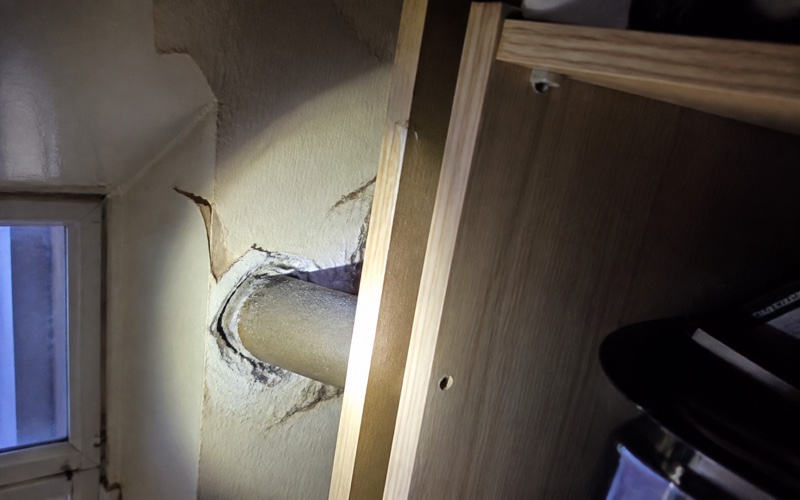
1. The source is outside the treated space
The most common reason in blocks of flats. If the colony survives in a neighbour's flat, in the basement or in the stairwell, the insects come back through the ventilation shafts and the pipe runs.
In Soviet-era Riga blocks the shared ventilation shaft connects flats vertically up an entire riser, and the openings around pipes are often simply unsealed. Cockroaches and bedbugs use both routes routinely.
What to do: barrier treatment at the crossing points and, where possible, coordinated treatment of several flats at once. See pests from neighbours.
2. The residual layer was washed off too soon
A very common and entirely avoidable mistake. After the treatment someone does a thorough clean, washes the skirting boards and the insides of the cupboards — and removes exactly the layer that was supposed to kill the generation hatching from the eggs.
What to do: leave the treated zones unwashed for 2-4 weeks. Wipe the worktops and the surfaces you touch, and leave the perimeter alone. See what to do after treatment.
3. The harbourage was never found
If the room was treated but the harbourage was not, new insects keep appearing. Typical examples: a fly breeding site in a floor void or ventilation shaft, drain fly larvae inside the trap, a moth source in one forgotten packet at the back of the cupboard, an ant nest outside the building.
What to do: a deliberate search for the harbourage, often in other rooms or outside the building entirely. This is why we ask where and when you see the insects rather than only where you want us to spray.
4. Incomplete preparation
If the cupboards were not emptied, the furniture not pulled out or the textiles not washed, some harbourages stay untreated and the colony survives in them. From the occupant's point of view the treatment covered the flat; from the colony's point of view it did not.
What to do: follow the preparation list in full. See how to prepare your property.
5. Reintroduction
The insects are brought in again: bedbugs after another trip, cockroaches with a delivery, fleas from an animal that was not treated in parallel with the flat.
What to do: close the route of entry. See bedbugs after travel and flea treatment.
Reintroduction is worth distinguishing from failure, because the remedy is completely different. A treatment that worked and was then undone by a suitcase does not need a stronger product.
When it is not a recurrence at all
Two situations are often mistaken for a failed treatment:
- More insects in the first days. This is normal — the product drives them out of their harbourages. It is a sign the treatment is working.
- Isolated new individuals after 1-2 weeks. These have hatched from eggs and will pick up the residual layer. It is anticipated and built into the plan, which is exactly why a second treatment is scheduled in some cases.
A real recurrence is activity that is unchanged or increasing after 3-4 weeks.
If that happens, fill in the form and describe the situation: when the treatment was done, what has changed, and where exactly the insects are appearing. That is usually enough to identify which of the five reasons applies. Repeating the same work without establishing the cause would most likely produce the same result, so the first step is diagnosis rather than another spray.
Most recurrences are preventable, and it has nothing to do with how strong the product is. Five habits cover almost all of it.
- 1
Prepare properly the first time.
An untreated wardrobe or an unmoved sofa is a reservoir the treatment never touched, and it will repopulate the flat on its own timetable.
- 2
Leave the perimeter unwashed for a month.
If a second treatment is planned, count the month from that visit rather than the first.
- 3
Seal the routes in.
Pipe runs around the risers, ventilation grilles, the gap under the front door. In a Riga block these are the motorways between flats.
- 4
Deal with the water and the food.
Dripping taps, a wet sink overnight, crumbs behind the cooker. This does not kill a colony, but it decides whether a few arrivals can establish one.
- 5
Change the habit that brought them in.
Where the cause was luggage or second-hand furniture, the treatment fixes the flat and not the habit.
Where the source is genuinely outside your walls, none of this eliminates the risk on its own — but it is the difference between a stray insect and a re-established colony.
Book a pest control visit
Fill in the form — we reply within 5 minutes. We work weekends and handle urgent callouts.