
Is pest control dangerous?
This is the question people ask most often before booking, and it is a fair one. The short answer: a correctly performed treatment with professional products is safe once it has dried and the rooms have been aired, and there is also a method that uses no chemicals at all.
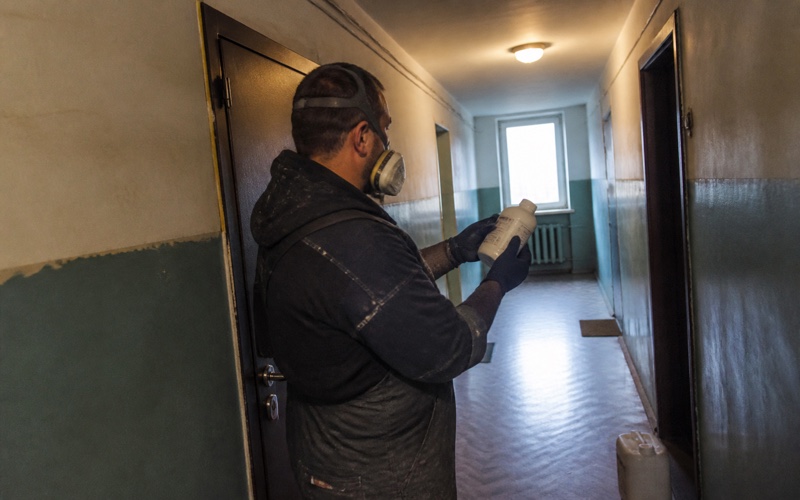
Why professional products are not more dangerous than shop ones
The common assumption is the opposite: that professional products are stronger and therefore more dangerous. In practice that is not how it works.
Professional preparations are more effective not because they are more toxic but because they are microencapsulated and have a long residual action. The amount of active substance is often lower than in a shop aerosol, but it stays active for weeks instead of hours.
The second difference is how it is applied. A professional treatment is targeted and placed — into gaps, behind furniture, along skirting boards — rather than sprayed around the room and over surfaces, which is what most people do when they try to deal with it themselves.
Why they affect insects and not you
Most modern insecticides act on receptors in the insect nervous system whose structure differs substantially from the equivalent receptors in mammals. At doses that are lethal to an insect, the effect on a person or a pet is many times smaller.
Body mass matters too. An insect walks across a treated surface with its entire body, weighs a fraction of a gram, and has no way to avoid the contact. A person's contact is indirect and, once the product has dried, minimal.
This is also why the drying time matters more than the smell. A dried, targeted deposit in a gap behind a skirting board is not something anyone in the household comes into contact with in normal use.
It follows that in safety terms the decisive factor is not the substance but the dose and the way it is applied — and that is precisely where a professional treatment differs from DIY.
- The label sets the concentration. Every registered product has a permitted dilution and a permitted rate per square metre, and there is no benefit in exceeding it — a higher dose does not kill insects that are resistant, it just costs more and leaves more residue.
- The area is measured, not guessed. That is why we ask about the size of the property in the enquiry form.
- Placement replaces volume. Two grams in the right gap outperforms two hundred grams sprayed across a wall.
The typical DIY failure is the reverse: an unmeasured amount of an unsuitable product applied across large open surfaces where insects do not live.
When extra caution is needed
Tell us in the enquiry form if the property has:
- small children or babies;
- a pregnant woman;
- anyone with asthma, a respiratory condition or a known chemical allergy;
- pets, and especially aquarium fish and amphibians, which are the most sensitive of all to insecticides;
- someone bedbound or seriously ill who cannot be moved.
In these cases we change the method, plan a longer airing period, or offer heat treatment with no chemicals at all.
The chemical-free method
If chemicals are not acceptable in any quantity, heat treatment is available: the insects are killed with controlled heat at around 60 °C, with no preparations of any kind.
Nothing chemical is left in the room afterwards, and the space is usable as soon as it has cooled. There is no drying time, no airing period and no residue question. See also chemical-free pest control.
If someone does react, that is uncommon after a correctly performed treatment, but sensitive people can experience mild airway or skin irritation.
What to do: air the flat thoroughly again, wipe down the accessible surfaces with water and detergent, and keep the person out of the treated rooms until the irritation settles. If symptoms are more than mild, or involve breathing, see a doctor. We are not a medical service and we do not give treatment advice.
Tell us as well, because it changes what we use in your property next time.
What professional products actually are
People reasonably ask what we work with, and the answer is more specific than most expect.
- Microencapsulated pyrethroids. The active substance is held in microscopic capsules that release it slowly, which is what gives the long residual action. This is the standard for flat treatments.
- Non-repellent actives. Insects cannot detect them, so they walk across the deposit instead of avoiding it, and carry it back to the harbourage. Crucial for cockroaches and ants.
- Insect growth regulators. They do not kill adults but stop nymphs reaching a breeding stage, which is how a cycle is broken rather than trimmed.
- Gel baits. A tiny quantity placed out of reach, eaten and passed through the colony.
All of these are registered products used at label rates. None of them is the fog of poison people picture when they hear the word, and the quantity involved in a one-bedroom flat is measured in grams.
Honestly about risk
There is no zero-risk activity involving chemical substances, including using household cleaning products. The real question is whether the risk is managed.
In practice that means: the correct dose, targeted application, an adequate absence and airing period, and a method chosen to suit who actually lives in the property. If those conditions are met, the treatment is safe.
It is also worth some perspective. Most homes already store bleach, oven cleaner and drain unblocker under the sink, in far larger quantities and in far more concentrated form than the few grams of a diluted insecticide placed into gaps during a flat treatment. That does not make either harmless — it means the honest comparison is with everyday household risk, not with something exotic.
If anyone tells you an insecticide is completely harmless in all circumstances, that is not an honest answer.
Book a pest control visit
Fill in the form — we reply within 5 minutes. We work weekends and handle urgent callouts.