
Chemical treatment with residual action
Chemical treatment with residual action is the backbone of pest control. What matters is not the moment of application but the fact that the product stays active on surfaces for weeks afterwards.
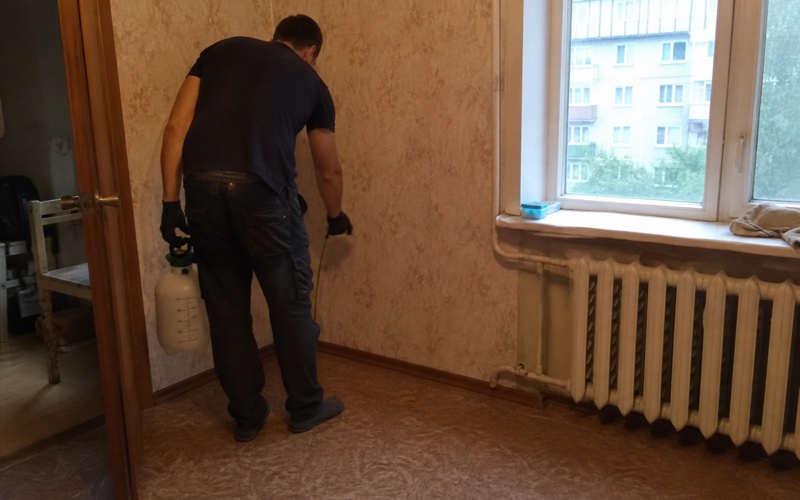
Why residual action is the decisive part
Almost no insecticide kills insect eggs; a tough shell protects them. That means even a treatment that kills every living insect is followed 7 to 14 days later by a new generation hatching out.
A product with residual action solves that: the active ingredient stays on the treated surfaces for 4 to 6 weeks, and the newly hatched nymphs die as soon as they start moving.
This is exactly what separates a professional treatment from a shop-bought aerosol, which works only on direct contact and loses its activity within hours. See why shop products fail.
Microencapsulated products
Modern professional products are microencapsulated: the active ingredient sits inside tiny polymer capsules that release it gradually.
That gives several practical advantages — longer action, less smell, lower risk of marking surfaces, and a lower environmental load, because the total quantity of active ingredient is smaller than with traditional formulations.
Where treatment is and is not applied
A professional chemical treatment is not a matter of spraying the room. The product is applied deliberately where insects travel and hide.
- Treated: skirting boards and the gaps behind them, cracks in walls and ceilings, behind and under furniture, furniture joints and screw holes, mattress seams and the bed frame, pipe entries and ventilation openings, around sockets, and the perimeter of doors and windows.
- Not treated: food preparation surfaces, the dining table, crockery and kitchen utensils, children’s toys and cots, surfaces within a child’s reach, and pet bowls and bedding.
If any of those is touched indirectly during the work, it is cleaned once dry, before the room is handed back.
Resistance, and how it is handled
Resistance means an insect population has become tolerant of a specific active ingredient. It is not a myth, and in Latvia it is a real problem, particularly with bedbugs and cockroaches.
The mechanism is simple: when the same substance is used for decades, the hardier individuals survive and breed, and each generation is a little more tolerant. This is the main reason shop aerosols, almost all pyrethroid-based, no longer work in many populations.
Professionally it is handled two ways. First, rotating active ingredients, so the same product is not used repeatedly at the same site. Second, combining methods: against a resistant bedbug population the best answer is heat treatment, because resistance to heat is not possible.
If previous treatments have failed, say so in the enquiry. It is important information for choosing the method.
Safety
We use professional products permitted in the European Union. Once dry and after airing, treated rooms are safe to use.
The standard requirement is to leave the rooms for 2 to 4 hours and then air them well. In homes with children, pets or anyone with allergies we plan an extended airing period and clean the accessible surfaces — or recommend heat treatment, which uses no chemicals at all.
How long the effect lasts in practice
The stated 4 to 6 weeks is a range rather than a promise, and what moves it is worth understanding.
- Surface type. Porous surfaces such as bare plaster and untreated wood absorb the product and shorten its useful life; sealed and painted surfaces hold it near the top where insects walk on it, which lasts longer.
- Cleaning. Washing a treated zone removes the residual film. This is the most common way a good treatment is unintentionally cancelled a week after it was applied.
- Humidity and temperature. Damp basements and hot plant rooms both degrade residues faster than a dry living room.
- Sunlight. UV breaks down active ingredients, which is why outdoor perimeter treatments are shorter-lived than indoor ones and are repeated seasonally.
The practical consequence: do not wash the treated gaps and skirting zones for several weeks, and expect an outdoor perimeter to need renewing within a season rather than lasting a year.
Why microencapsulation changes the result
The distinction between a modern professional product and an older one is not raw strength but delivery, and it explains most of the difference in outcome.
In a conventional formulation the active ingredient sits exposed on the surface. It degrades under light, absorbs into porous materials and is removed by the first clean, so the useful window is short. In a microencapsulated product the active ingredient is held inside polymer capsules that sit on the surface and release it slowly, and insects pick the capsules up as they walk across.
The consequences are practical rather than theoretical: the treatment stays effective for weeks instead of days, the smell is much weaker, staining risk is lower, and the total quantity of active ingredient used is smaller than an older formulation would need for the same result.
It is also why an aerosol bought in a shop is not a smaller version of what we use. It is a different category of product with a different failure mode — see why shop products fail.
Book a pest control visit
Fill in the form — we reply within 5 minutes. We work weekends and handle urgent callouts.