
Wasp nest removal
Wasps become aggressive when defending a nest and, unlike bees, they can sting repeatedly. Removing a nest without protective equipment and experience is a genuine health risk, particularly for anyone with an allergy.
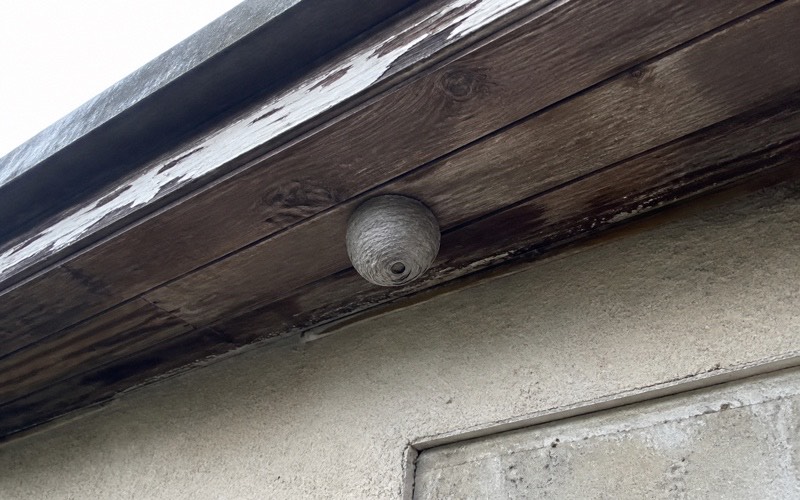
How to spot it
Steady wasp traffic
A constant stream of wasps in and out of one specific point - a gap, a vent or the edge of the roof.
A papery nest
A grey, layered, paper-like structure in the loft, under the roof soffit or in a shed.
Noise inside a wall
A quiet, steady rustling or scratching from a wall cavity or ceiling void.
Wasps at ground level
Ground-nesting wasps use abandoned rodent burrows; the entrance looks like a small hole in the lawn with busy traffic.
Wood shavings or debris below
Fine papery flakes on the floor beneath a loft hatch or soffit can mark the nest above.
Why you should not remove a nest yourself
Wasps read vibration and any approach to the nest as an attack. A disturbed nest releases dozens of defensive wasps within seconds, and unlike a bee a wasp does not lose its sting - it stings repeatedly.
There is a second risk that gets overlooked. Nests are often at height - a roof edge, a loft - so the work happens on a ladder, and panicking during a sting while on a ladder is more dangerous than the sting itself. Using an aerosol from close range typically just enrages the colony.
Allergy: for anyone allergic to hymenoptera venom a single sting can cause an anaphylactic reaction. In that case do not approach the nest at all, under any circumstances. See wasp sting first aid.
How the removal is done
The technician works in a full protective suit with a face veil. The product is introduced directly into the nest or into its entrance hole, rather than sprayed around the area - that destroys the colony including the queen and the brood.
If the nest is accessible, we take it down once the colony is dead. If it sits inside a wall cavity or another unreachable space, it is neutralised in place and the entrance is sealed, so a new colony does not settle in the same spot next season.
The work is usually done in the evening or early morning, when almost the whole colony is inside the nest. That gives a much more complete result than a daytime treatment, when a large share of the workers are out foraging.
Where nests turn up around Riga homes
- Loft spaces and roof voids. The most common location by a distance, especially where a soffit or ridge vent gives easy access.
- Under balcony ceilings and eaves, including on upper-floor flats in blocks.
- Inside wall cavities, entered through a gap in the cladding or around a window frame.
- Sheds, garages and summer houses, which are quiet and undisturbed through the spring.
- In the ground, in old rodent burrows in a lawn or under decking.
- In dense hedging, where the nest is invisible until someone starts trimming.
Where the nest is on a summer house or garage, see summer houses and garages.
The season and why timing matters
In spring the nest is founded by a single overwintered queen and stays small. By late summer and early autumn the colony reaches its maximum - and that is exactly when wasps become most persistent and most aggressive, because they are hunting for sugar rather than protein.
The earlier a nest is dealt with, the simpler and safer the job. After the first frosts the colony dies naturally, but the old nest is still worth removing, because it attracts other pests that feed on the debris inside it.
In Riga the practical window runs from about May, when nests become noticeable, to October. Late-August callouts are the busiest, which is worth knowing if you are planning around an event or a garden party. See the seasonal guide.
What to do while you wait
- Keep everyone away from the entrance - a radius of a few metres is enough for most nests.
- Close the windows on that side of the building, particularly at night if the nest is near a lit window.
- Do not block the entrance hole. Wasps will chew a new exit, sometimes into the room rather than outside.
- Do not spray from a ladder or from a window.
- Cover outdoor food and drinks, and check the rim of an open can before drinking from it.
Wasp nest removal is from 60 euros. If somebody in the household has a known venom allergy, say so in your enquiry and we will treat the callout as urgent - see emergency callout.
Wasps, bees and hoverflies
Before booking a nest removal it is worth being sure what you have, because the answer changes what should be done.
- Wasps are bright yellow and black with a smooth, almost hairless body and a distinct narrow waist. They build grey papery nests and sting repeatedly.
- Honeybees are browner and furry, and a swarm hangs as a dense cluster rather than occupying a papery structure. Bees are protected and valuable, and a swarm should go to a beekeeper rather than be destroyed - we will tell you if that is what you have.
- Bumblebees are large, round and furry, nest in small numbers in the ground or in cavities, and are very reluctant to sting. A bumblebee nest dies out naturally by late summer and is best left alone where possible.
- Hoverflies mimic wasp colouring but have no sting at all, hover in one spot, and have short antennae and large eyes.
If you are not sure, describe the nest and the insect in your enquiry, or send a photograph taken from a safe distance.
Wasps in a flat or on a balcony
Nests on balconies and in the roof voids of blocks of flats are common in Riga from July onwards, and they raise a practical question about responsibility.
A nest inside your own balcony structure or on your window reveal is normally yours to deal with. A nest in the loft, in the facade cladding or in a shared roof void is part of the building's common property, which makes it a matter for the building manager (apsaimniekotajs). If you are a tenant, tell your landlord and the manager in writing on the same day - it usually speeds things up considerably.
In the meantime, keep the balcony door shut, avoid the flight path and do not attempt to knock the nest down. A nest disturbed on a balcony has nowhere to disperse to except the flat.
Book a pest control visit
Fill in the form — we reply within 5 minutes. We work weekends and handle urgent callouts.