
Hornet nest removal
Hornets are the largest hymenoptera in Latvia, up to 35 mm long. They are less aggressive than wasps, but the sting is more painful and a disturbed nest is a serious risk.
How to spot it
Large insects
A hornet is noticeably bigger than a wasp - 25 to 35 mm, with a brownish-red thorax.
A loud flight sound
A characteristic low, loud drone, much more pronounced than a wasp.
Activity in the evening
Unlike wasps, hornets are drawn to light and fly at dusk and after dark.
A nest in a cavity
Often in a hollow tree, a loft, a shed or under roof timbers.
Stripped bark on shrubs
Hornets strip bark from young branches for nest material, leaving pale patches.
How hornets differ from wasps
The hornet (Vespa crabro) is considerably larger than a common wasp and flies with a lower, louder sound. Contrary to a widespread belief, hornets are not more aggressive than wasps - unprovoked they generally do not attack, and they pester people at a picnic table far less.
What is different is the defensive zone around the nest, which is wider, and the sting, which is more painful because of the larger dose of venom. There is one more practical difference: hornets are attracted to artificial light, so they will fly in through a lit window in the evening. Closing windows on that side of the house after dusk is usually enough to stop it.
How the removal is done
Hornet nests are often in awkward places - hollow trees, loft structures, under the roof. The work is carried out in a full protective suit, normally in the evening when the whole colony is inside the nest.
The product is introduced directly into the nest or its entrance. If the nest is accessible, we remove it once the colony is dead and seal the entrance so a queen does not choose the same spot the following spring.
Removing a hornet nest without protective equipment is dangerous. Several stings in a short period are a serious health risk even for a person with no allergy, and a single sting can be an emergency for someone who is allergic - see sting first aid.
When a hornet nest needs removing
Not every hornet nest has to go. Hornets are useful predators, taking large numbers of flies and other insects, and a nest at the far end of a large plot with nobody passing it does little harm.
Removal is warranted when the nest is close to the house, above a path or doorway, near a children's play area, in a loft that people use, or where somebody in the household has a venom allergy. Where you are unsure, describe the location in your enquiry and we will tell you honestly whether it needs dealing with.
The season for hornets
A single overwintered queen starts the nest in May. Through June and July the colony grows steadily, reaching its largest size in August and September, when a mature nest can hold several hundred individuals.
After the first frosts the colony dies out naturally and only new queens survive to overwinter elsewhere. The old nest is never reused, but it is worth removing from a loft because the debris inside attracts beetles and moths.
The earlier in the season a nest is dealt with, the smaller the colony and the simpler the job.
Living alongside a nest until we arrive
- Keep a few metres clear of the entrance and mark it so nobody walks into the flight path.
- Close windows on that side after dark or fit insect mesh - this stops the evening fly-ins.
- Do not use outdoor lights near the nest in the evening.
- Do not block or seal the entrance while the colony is alive.
- Keep pets away from the area, since a dog investigating a ground-level entrance is a common cause of multiple stings.
If access is difficult - a high roof or a hollow tree - tell us in the enquiry so we bring the right equipment first time.
What a hornet nest looks like
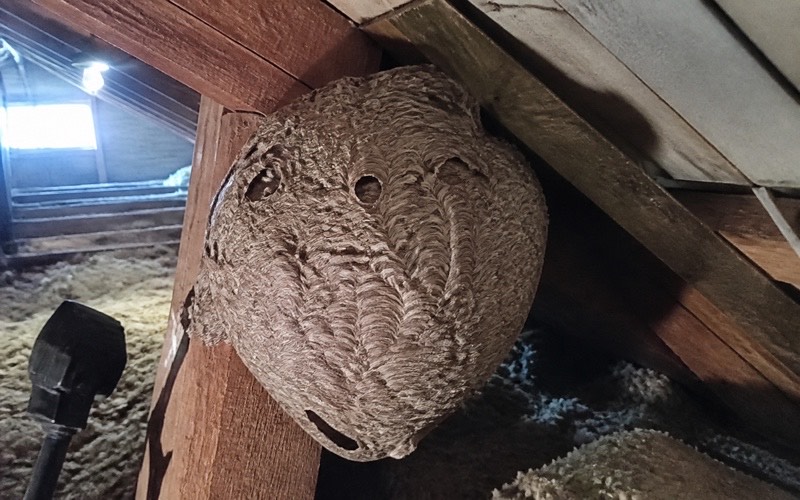
The nest is built from chewed wood fibre and looks like coarse grey or brownish paper, softer and more open in texture than a wasp nest. Early in the season it is the size of a golf ball; by August a mature nest can be the size of a football or larger.
In a loft the nest is usually suspended from a rafter or built into the insulation. In a hollow tree it fills the cavity and only the entrance is visible. In a wall it is invisible entirely, and the only sign is the traffic at a single hole plus a low humming from inside the wall on a warm evening.
An old nest from a previous season is dry, brittle and empty, and is never recolonised. If you are unsure whether a nest in your loft is live, watch the entrance for a couple of minutes in daylight: a live nest shows a steady stream in and out.
Book a pest control visit
Fill in the form — we reply within 5 minutes. We work weekends and handle urgent callouts.