
Bedbug treatment in Riga
Bedbugs are among the toughest pests you can get in a home. They feed on blood at night, hide in the narrowest cracks and breed quickly, which is why shop-bought sprays almost never finish the job. We treat every harbourage and deal with the colony at all stages of development.
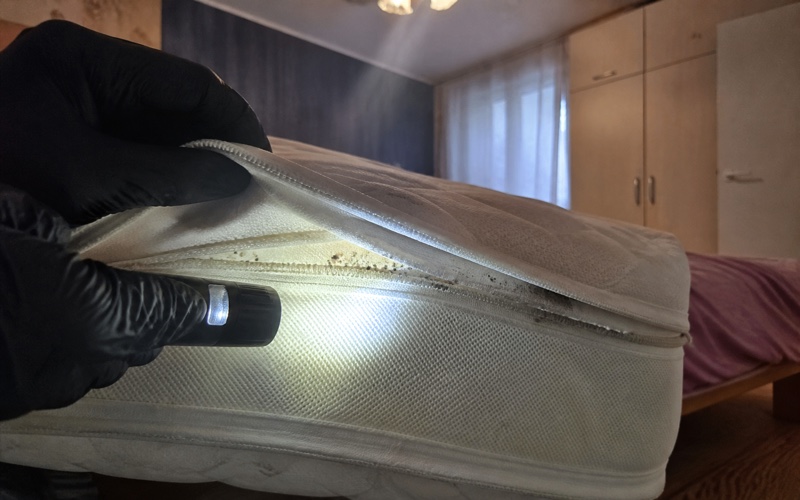
How to spot it
Bites in a line or cluster
Red, itchy bites often sit in a straight line or a small group on exposed skin - arms, neck, shoulders, legs.
Dark specks on the mattress
Tiny black dots (bedbug droppings) along mattress seams, in bed frame joints and behind the headboard.
Blood spotting
Small reddish-brown marks on the sheet or pillowcase, from bugs crushed after feeding.
Shed skins
Transparent, empty shells around the bed. A bedbug moults five times before it reaches adulthood.
A distinctive smell
A sweetish, unpleasant odour that becomes noticeable in a heavy infestation.
Live insects
Flat, oval, brown insects 4-7 mm long. Swollen and darker after a blood meal.
Why bedbugs turn up in a flat
Bedbugs have nothing to do with how clean your home is. They arrive in luggage, in second-hand furniture, on clothing or in books, and they are found just as often in modest flats as in expensive ones.
In Riga's blocks of flats bedbugs move between apartments through gaps in walls, floor joints, shared ventilation shafts and electrical conduits. Soviet-era blocks in districts such as Purvciems, Kengarags and Imanta were built with a single ventilation shaft serving a whole vertical stack of flats, which is exactly the route insects use. That means the source can be in a neighbour's flat even if you have brought nothing in yourself.
They are extremely resilient: without a blood meal they survive for months, in some cases up to a year, and they tolerate a wide range of temperatures. A single fertilised female can produce hundreds of descendants within a few months.
The life cycle, and why it sets the treatment plan
To understand why bedbug control is rarely a one-day job you need to know how the insect develops. A female lays 200-500 eggs over her lifetime, five to twelve a day, and glues them into cracks where they cannot realistically be washed or vacuumed out.
A nymph hatches within 6-10 days. It passes through five stages before adulthood, and before each one it must take a blood meal. At room temperature the whole cycle takes five to seven weeks. One pregnant female arriving in January can leave you with a colony of several hundred by spring.
Two practical consequences follow. First, an infestation is never at a single stage - adults, nymphs and eggs are present at the same time, and each responds differently. Second, it is the toughness of the eggshell that makes treatment a process rather than a single event.
This is also why the advice to go away for a month and starve them out does not work. You come back to a colony that is alive, and hungry.
Where exactly they hide
Bedbugs choose a harbourage by three criteria: dark, narrow, and close to a sleeping person. In practice that produces a clear hierarchy of places, and a professional treatment works straight down it.
Primary harbourages - 90% of cases
- Mattress seams, labels and button recesses.
- Bed frame joints, screw holes and glued sections.
- The back of the headboard and its wall fixings.
- The inside and corners of an ottoman storage base.
Secondary harbourages - in a wider infestation
- Bedside table drawer runners and undersides.
- Skirting boards and parquet gaps near the bed.
- Behind sockets and light switches on the wall by the bed.
- Under lifting wallpaper and behind pictures or mirrors.
- The sofa, armchairs and other soft furniture in the same room.
If bugs have reached the secondary harbourages, the infestation has been running for several months. In that case we treat not only the bedroom but every room where somebody regularly sits for more than an hour.
Why shop-bought products usually fail
Aerosols from the shop only affect the bugs they physically hit. They do not reach insects deep in mattress seams, furniture joints and behind skirting boards, and they have no effect on eggs.
On top of that, many bedbug populations have developed resistance to the widely available pyrethroids. The result is familiar: the visible bugs disappear for a few days, then after 7-10 days a new generation hatches.
Home remedies - vinegar, lavender, essential oils - repel bedbugs briefly but never destroy a colony. Steam kills on contact, but only where it physically reaches. The one genuinely useful thing you can do yourself is washing textiles at 60 degrees and thorough vacuuming: both physically remove part of the population, eggs included. More on this in why shop products fail.
How the treatment is carried out
Once we have your enquiry we confirm the details and choose the method to suit the scale of the infestation and the property.
- 1
Inspection.
We check the bed, soft furniture, skirting boards and furniture joints with a torch to establish how far the infestation has spread. That determines how widely we treat.
- 2
Choice of method.
A light or moderate infestation is usually handled with a residual chemical treatment. A heavy or long-running one, or a home where chemicals are not wanted, calls for heat treatment or a combination of both.
- 3
Harbourage treatment.
The product goes directly into the cracks - mattress seams, frame joints, skirting boards, behind sockets - rather than being sprayed across surfaces.
- 4
Perimeter treatment.
We treat the entry routes: ventilation grilles, pipe runs, the door perimeter. In a block of flats this is what makes it harder for bugs to walk back in from next door.
- 5
Instructions.
We explain how long to stay out, what may and may not be washed, and what to expect over the following weeks.
A one-room flat normally takes one to two hours for a chemical treatment. Heat treatment takes longer, because the room has to be brought up to temperature gradually and held there. We use professional microencapsulated insecticides that stay active for several weeks, which matters: the product is still working when the next generation hatches out of the eggs.
How many treatments you will need
Usually one or two, with a 10-14 day interval. The reason is biological: no insecticide reliably penetrates the eggshell, so the second visit is timed for the moment when the new generation has hatched but has not yet reached breeding age. See how many treatments are needed.
If bedbugs are also in neighbouring flats, those should be treated at the same time, otherwise the insects simply return along the same routes. More on that in pests from neighbours. Where a whole stairwell is affected, the building manager (apsaimniekotajs) usually coordinates it - see for property managers.
An honest limit. If the source is a neighbour's flat and that flat is not treated, we cannot promise the problem will not come back. In that situation we treat your flat with a reinforced barrier at the crossing points and tell you plainly what that does and does not achieve.
What to expect afterwards
In the first few days activity can look worse than before. That is normal - the product drives the bugs out of their harbourages and makes them visible. Do not start spraying anything extra at this point; it only scatters the colony.
After the first week activity drops sharply. Over the next two weeks you may see occasional new individuals hatched from eggs; they pick up the residual layer and die. If the treatment was thermal, this phase usually does not happen at all.
The single most important rule: do not wash the treated surfaces - skirting boards, cracks, frame joints - for the next two to four weeks. The residual layer is what finishes the job. Full guidance is in what to do after treatment, and preparation in how to prepare.
Book a pest control visit
Fill in the form — we reply within 5 minutes. We work weekends and handle urgent callouts.