
Pests coming from the neighbours
This is one of the most common and least pleasant situations: insects in your flat but the source next door. You can treat your own flat, but you cannot make a neighbour treat theirs, and it is worth being clear about what that means in practice.
How to tell the source is next door
Signs that point that way:
- The insects appeared suddenly and in numbers, with nothing brought in — you have not bought, carried or moved anything.
- It coincided with building work, a treatment or someone moving out in a neighbouring flat.
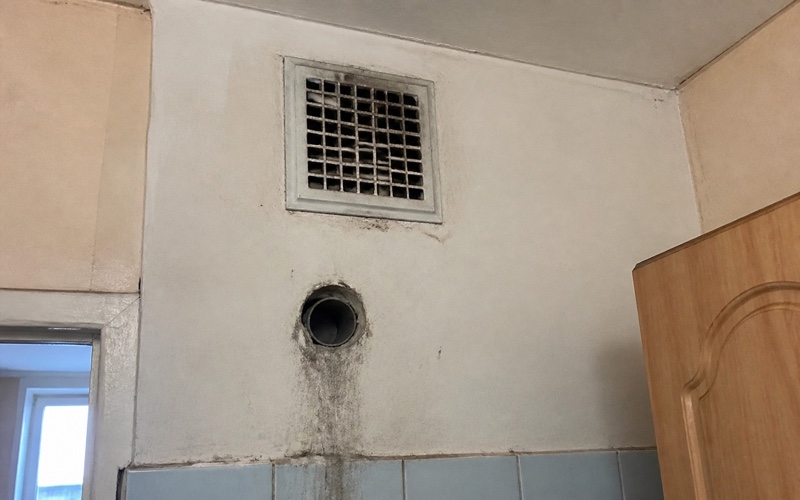
- The insects concentrate around ventilation openings, pipe runs or the front door, rather than around food or the bed.
- After a treatment they return within a few weeks even though there are no signs of breeding in your flat.
Cockroaches and bedbugs usually move vertically — up and down a single riser — more often than horizontally. So the flat above or below yours is a more likely source than the one next door.
Narrowing down which flat
Pinpointing the exact source is not always possible, but a few observations narrow it a great deal.
- Which room first. Insects appearing first in the bathroom or kitchen point to the riser; first in the hallway points to the stairwell and the front door.
- Time of day. Cockroaches arriving in numbers at night usually means an established colony close by rather than an occasional wanderer.
- What changed and when. A neighbour's renovation, a flat standing empty, a new tenant, a treatment next door — all of these push insects outward.
- Talk to the neighbours. Awkward, but often the fastest route. In many buildings several people have the same problem and none of them knows about the others.
What you can do in your own flat
Even if the source is next door, a barrier can be created in your flat that makes entry substantially harder:
- Treatment of the ventilation openings and their surroundings, and checking the grille mesh.
- Sealing the pipe runs in the bathroom and kitchen — in Soviet-era blocks these are often simply open gaps around the risers.
- Treatment and sealing of the front door perimeter and threshold.
- Treatment of the skirting boards and sockets on the shared walls.
Honestly about what to expect: a barrier treatment reduces entry and eliminates what is already inside, but it does not guarantee complete protection while the colony next door survives. Anyone who promises otherwise is not being straight with you.
The building manager's role
Shared spaces — the basement, the stairwell, the refuse room, the ventilation shafts — are the responsibility of the apsaimniekotajs (the building manager) or the owners' association, not of an individual flat owner.
If the problem affects several flats, the route is a written submission to the building manager. It works considerably better when several flat owners sign it, because one complaint reads as one person's problem and five read as a building's problem.
We work directly with building managers — see pest control for property managers. If it helps, we can provide a description of what we found after a treatment, to attach to the submission.
If the building manager does not act
The situation where the problem is in the shared areas and nothing happens is common and frustrating. A few practical steps.
- 1
Put it in writing and keep a copy.
A verbal complaint leaves no record and no date. Email or a formal letter, both fine.
- 2
Collect signatures.
Several flat owners on one submission changes the response rate more than the wording does.
- 3
Document it.
Photographs with dates, and a note of when insects appear and where.
- 4
Raise it at the owners' meeting.
Treatment of shared areas is a decision that can be taken there, and it is usually a small sum per flat.
- 5
Meanwhile, protect your own flat.
Barrier treatment and sealing are worth doing regardless of how the shared-area question resolves.
We are not lawyers and we do not give legal advice. These are practical observations from working in Riga's residential blocks.
Why coordinated treatment is the only complete answer
Treating several flats on one riser at the same time, together with the shared spaces, is the only way to eliminate a colony completely. Otherwise the insects simply relocate to the untreated flat and return afterwards.
In practice this usually costs less per flat than repeated individual treatments, because the problem is solved once instead of being pushed around the building for a year. Commercial and multi-flat work is quoted after a survey.
Book a pest control visit
Fill in the form — we reply within 5 minutes. We work weekends and handle urgent callouts.