
Pest control in basements and stairwells
Shared areas are where an insect problem in a block of flats most often begins, and they are also the one place an individual flat owner can do almost nothing about.
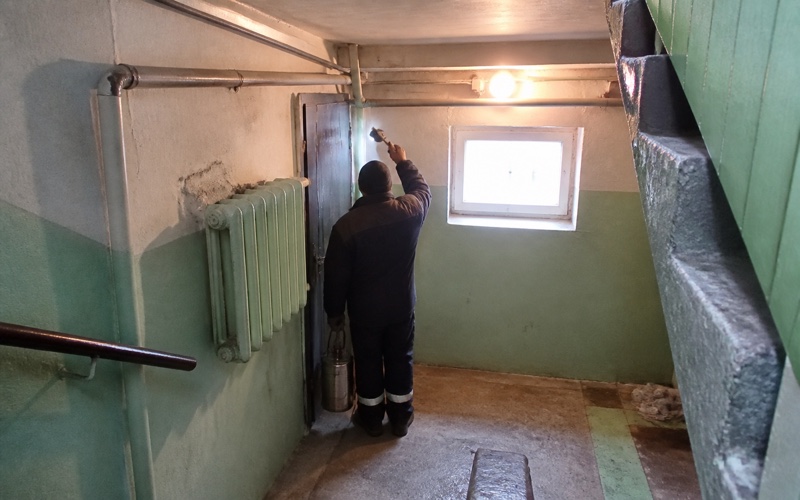
Why the basement is the source
A basement combines every factor insects favour: damp, a stable temperature, darkness, few visits from people, and usually stored belongings, cardboard and organic material.
From there they spread upwards through the pipe risers and ventilation into the flats. So if the source is in the basement, treating a single flat gives only a short-lived result — and the residents reasonably conclude that the work was done badly, when the real issue was its scope.
The common pests here are cockroaches, silverfish, spiders and earwigs.
Who orders this work
Shared areas are not the responsibility of an individual flat owner. They are managed by the building manager or the residents’ association — in Latvian, the apsaimniekotājs, the company or association that manages your building and issues the monthly bill.
In practice that means a problem in the basement or stairwell has to go to them. We work directly with building managers and associations — see pest control for property managers.
If you are a resident and the manager is not responding, we can prepare a written description of what we found, which you can submit to them. In our experience a specific, dated document moves things along far better than repeated phone calls.
Damp is the root cause
In most cases a basement problem is a moisture problem. Blocked ventilation, leaking pipes, condensation and flooded corners create an environment where insects breed continuously.
The treatment kills the existing population, but if the damp remains, the problem returns. So we always list the causes we found, so the manager has something concrete to fix.
Treatment does not fix damp. If the ventilation stays blocked or a pipe keeps leaking, expect the same species back within a season, whatever product was used.
Cost and coordination
Shared-area work is quoted after a survey, because the size of the basement, the number of stairwells and the condition of the space vary enormously between buildings.
Where the infestation has already reached the flats, the effective answer is simultaneous treatment of the shared areas and of several flats on the same riser. Treating them at different times simply moves the population back and forth.
What residents can and cannot do
This is worth stating plainly, because a lot of effort gets wasted here.
- What a resident cannot do: arrange treatment of the shared areas on their own account, get access to the technical rooms, or fix the ventilation and pipework causing the damp. Those sit with the building manager.
- What a resident can usefully do: report the problem in writing rather than by phone, with dates and locations; take photographs; clear their own cellar storage of cardboard and organic material; seal the gaps around pipe runs where they enter the flat; and coordinate with neighbours, because several written complaints move a manager far faster than one.
Treating your own flat while the basement stays untreated is not pointless — it buys relief — but it is a holding measure rather than a solution, and it is fair to know that before you pay for it.
Damp: what to fix before treating again
If a basement has been treated more than once for the same species, the treatment is not the variable that needs changing.
- Blocked or sealed ventilation. The most common cause in Riga blocks, often the result of vents being closed off to reduce draughts.
- Leaking pipework and valves, which supplies both water and warmth year round.
- Standing water after rain or snowmelt, particularly where drainage outside the building has failed.
- Condensation on cold pipes, which keeps surfaces permanently damp even with no leak at all.
- Stored cardboard and organic material, which is both shelter and food and holds moisture against the floor.
We list what we find in writing so the manager has something specific to act on. Insect treatment plus a damp survey is a solution; insect treatment alone is a subscription.
Book a pest control visit
Fill in the form — we reply within 5 minutes. We work weekends and handle urgent callouts.