
Earwig control
Earwigs are elongated brown insects with distinctive pincers at the rear. Despite the alarming appearance and the folklore, they are essentially harmless to people.
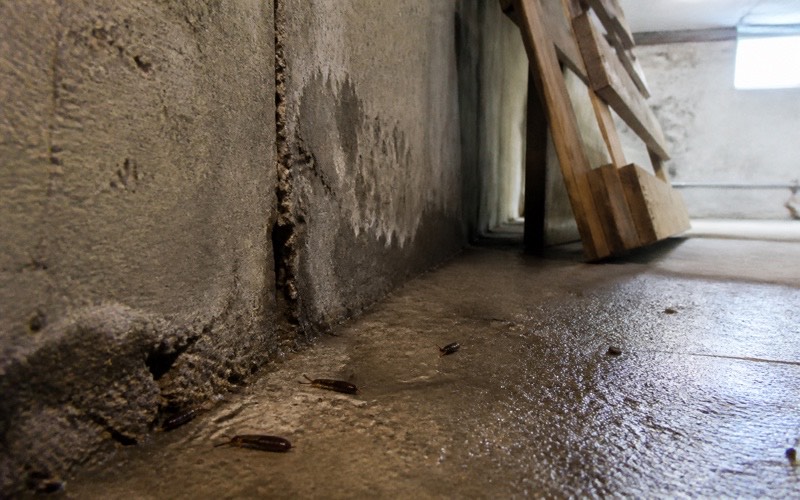
How to spot it
Pincers at the rear
The clearest identifying feature - curved pincers, more strongly curved on males than on females.
Activity at night
They hide in narrow, damp cracks by day and come out to feed at night.
Damp locations
Cellars, under plant pots, in decking gaps, under stones and in leaf litter.
Damaged plants
In the garden they can damage flowers and young shoots, though they more often feed on organic debris.
Numbers after rain
A wet spell followed by a sudden influx indoors is the usual pattern.
Are earwigs dangerous
No. The story about earwigs crawling into ears is folklore with no basis. The pincers are used for defence and in courtship; they cannot do a person any meaningful harm, and a nip is extremely rare.
The practical problem is different: earwigs indoors are unpleasant, and large numbers usually indicate excessive damp or accumulated organic matter close to the building. In that sense they are a useful warning sign rather than a threat.
They are also partly beneficial outdoors, feeding on aphids and decaying plant material, which is worth weighing before treating a whole garden rather than the building itself.
How to keep them under control
We treat the entry routes and harbourages: the building perimeter, foundation cracks, door and window reveals, decking gaps, cellar corners and ventilation openings.
A durable result comes from changing the environment: clearing leaf litter and branch piles away from the walls, moving the woodpile away from the building, reducing watering next to the foundations, sorting out the downpipes and sealing gaps.
See cellars and houses for how this fits with wider treatment of a property.
Why they come indoors
Earwigs are not house insects. They live outdoors and come inside for one of two reasons, both weather-driven.
In a dry summer they follow moisture, which is why they turn up around bathrooms and in cellars. After heavy rain they are flooded out of their outdoor shelters and come in through door thresholds and cellar windows. In autumn they seek somewhere frost-free to overwinter, which produces the September and October influx.
Because the population lives outside, treating only the inside of a flat gives a short result. The perimeter is where the work counts.
Practical prevention
- Clear organic debris from against the walls - leaves, cuttings, old mulch.
- Move firewood and stored timber away from the building.
- Fit door brushes and seals on ground-floor and cellar doors.
- Mesh cellar windows and air bricks.
- Check downpipes and drainage so water does not pool against the foundations.
- Reduce watering in the strip immediately next to the walls.
These measures cut the population close to the building, which is where the ones that get indoors come from.
What earwigs look like and what they do
An adult earwig is 10-15 mm long, reddish-brown, with a flat elongated body and the unmistakable pair of pincers, called forceps, at the tail end. Males have strongly curved forceps, females almost straight ones. They have wings folded under short wing cases and can fly, though they very rarely do.
They are nocturnal, thigmotactic - meaning they actively seek out tight contact on all sides, which is why they wedge themselves into the narrowest crack available - and omnivorous, feeding on decaying plant material, aphids, and occasionally soft plant tissue.
One detail is genuinely unusual among insects: the female guards her eggs and tends the young nymphs after hatching, cleaning the eggs to prevent mould. It has no bearing on treatment, but it does mean a nest under a paving slab is a family group rather than a colony in the ant or wasp sense.
How the treatment is timed
Because the population lives outdoors, the timing of a treatment matters more than it does for indoor pests.
The most effective time is late spring and early summer, when the nymphs have hatched and are active around the base of the building but before numbers peak in July and August. A perimeter treatment then reduces the population that would otherwise be pushed indoors by the first dry spell or the first heavy rain.
An autumn treatment is worthwhile too, aimed at the individuals looking for somewhere frost-free to overwinter, and it is usually combined with sealing the door thresholds and cellar windows that they use.
For an indoor problem in a flat we treat the flat itself, but we will always ask what is against the outside wall - because a woodpile or a bed of wet leaves under the window explains most of these cases.
Book a pest control visit
Fill in the form — we reply within 5 minutes. We work weekends and handle urgent callouts.