
Silverfish treatment
Silverfish are silvery-grey, scaly, wingless insects that move with a distinctive wriggling motion. They almost always indicate raised humidity in the room.
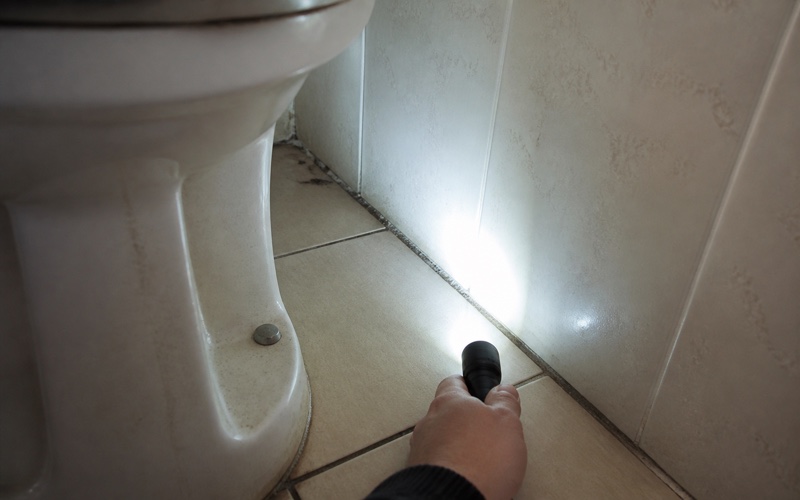
How to spot it
Insects on tiles at night
Switch the bathroom light on at night and they dart quickly into cracks.
Damaged paper
Irregular grazed patches on books, wallpaper and cardboard edges.
Silvery scale marks
Fine silvery traces left on light-coloured surfaces.
Concentrated around damp
Around the bath, shower, sink, washing machine and pipe runs.
Yellowish stains on fabric
On stored cotton and linen, where they have grazed the starch in the fibres.
Why damp is the underlying cause
Silverfish need high humidity - above roughly 70 per cent. Below that they do not survive or breed. Treatment without addressing the cause of the damp is therefore only a partial solution.
The usual causes in Riga flats: inadequate bathroom ventilation, a blocked ventilation shaft, condensation on cold pipes, drying laundry indoors, poorly sealed pipe joints and leaks under the sink.
In older blocks the shared ventilation shaft is a specific problem. If it has been blocked or a neighbour has fitted an extractor that pushes air back down it, the extraction in your bathroom stops working, humidity rises and silverfish follow. The building manager (apsaimniekotajs) is the person to raise this with, since the shaft is shared property.
In practice: restoring ventilation and fixing leaks usually gives a more durable result than any treatment.
How the treatment is carried out
We treat the places silverfish hide and travel: tile grout lines and gaps, skirting boards, pipe runs, the spaces behind and under sanitaryware, and the undersides and backs of cupboards.
We use products with a long residual action, because silverfish develop slowly - it can take several months from egg to adult, and the treatment has to remain active through that period. That is why the residual layer must not be washed off in the weeks afterwards.
See after treatment for the details of what to clean and when.
What they damage
Silverfish feed on carbohydrates, particularly starch and cellulose. In a home that means paper, book bindings, wallpaper paste, cardboard, photographs, and the starch and sizing in natural textiles.
The damage is slow and rarely dramatic, but it matters for stored documents, books and archives kept in a damp cellar or a cold storage room. Anything of value stored in a damp space is worth moving into sealed plastic boxes - which also, conveniently, tells you whether the population is still active.
Reducing humidity
- Run the extractor fan during and for at least twenty minutes after showering.
- Check the ventilation shaft draws. Hold a sheet of paper against the grille: if it does not stick, the shaft is not working.
- Dry laundry outdoors or in a ventilated room, not in a closed bathroom.
- Insulate cold pipes that develop condensation.
- Fix leaks under the sink and seal the gaps where pipes pass through walls.
- Consider a dehumidifier in a persistently damp cellar or utility room.
How to tell them from other insects
Silverfish are distinctive once you know what to look for, but they are regularly confused with two other insects.
A silverfish is 10-12 mm long, teardrop-shaped, covered in silvery scales, with two long antennae at the front and three tail filaments at the back. It moves in quick darting bursts with a fish-like wriggle and cannot climb smooth vertical surfaces, which is why they are so often found stuck in a bath or basin.
A firebrat is similar but mottled grey-brown and prefers hot, dry places such as the space behind a boiler. A house centipede, which alarms people far more, is longer-legged, much faster, and is actually a predator that eats silverfish - its presence is a sign of an insect food supply rather than a problem in itself.
Why they are hard to eliminate quickly
Silverfish are among the slowest-developing insects found indoors. It can take three months to two years for an egg to reach adulthood, depending on temperature and humidity, and adults live two to three years, moulting throughout their lives.
This changes the expected timeline. There is no dramatic collapse a week after treatment, as there is with cockroaches. Instead the numbers you see decline steadily over several weeks as insects encounter the residual deposit while moving between harbourages.
It also means patience is genuinely required: judging a silverfish treatment after ten days will always look disappointing. The measure that matters is how many you see after six weeks, and whether the humidity has actually come down.
Book a pest control visit
Fill in the form — we reply within 5 minutes. We work weekends and handle urgent callouts.