
Small flies and gnats in the flat
Tiny flies in a flat are one of the most common complaints we get, and the answer depends entirely on which species it is. The three usual suspects breed in completely different places.
How to spot it
Around fruit and wine
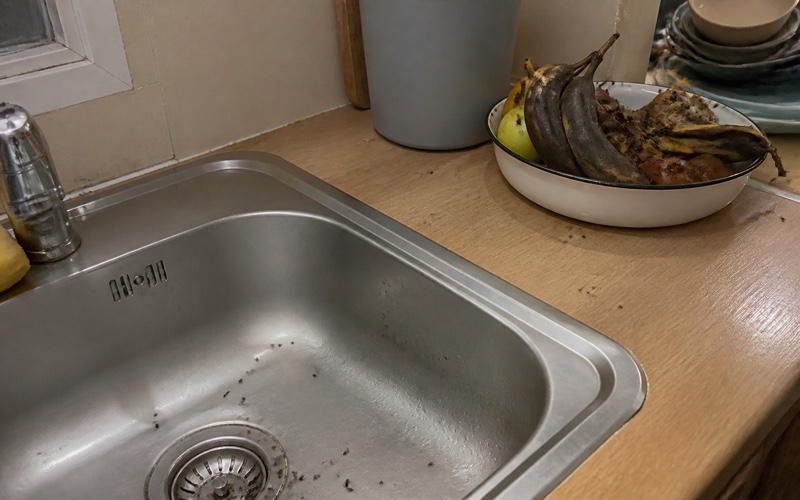
Fruit flies (Drosophila) - 2-3 mm, yellowish-brown with red eyes. They breed in fermenting fruit, juice, wine and the food caddy.
Around the sink and shower
Drain or moth flies - furry, with heart-shaped wings, sitting motionless on tiles. They breed in the biofilm inside drain traps.
Around plant pots
Fungus gnats - black and slender, like tiny mosquitoes. The larvae live in overwatered compost.
Around the bin
Could be any of the three - correct identification decides where the treatment goes.
Clustering at a window
All three head for light, so a window is where you notice them, not where they breed.
Why the species has to be identified
These three insects breed in completely different places, so a single all-purpose treatment does not work:
- Fruit flies - the source is fermenting organic matter: an over-ripe fruit bowl, spilt juice, the food waste caddy, bottles with dregs in them.
- Drain flies - the source is the biofilm inside the drain trap and waste pipe. Treating surfaces achieves nothing, because the larvae are inside the pipe.
- Fungus gnats - the source is overwatered houseplant compost. The solution starts with changing how you water.
So it is genuinely useful to say in your enquiry exactly where the flies gather - it lets us arrive prepared. See also small insects in the flat.
What you can do before we come
- Throw out over-ripe fruit, empty the food caddy and rinse bottles and jars.
- Check under the sink and behind the fridge - forgotten organic matter is very often there.
- Clean the trap mechanically for drain flies; chemical drain cleaners often fail to remove biofilm.
- Stop frequent watering for fungus gnats and let the top layer of compost dry out completely.
- Check the washing machine and dishwasher drain, which are commonly overlooked traps.
If the flies persist after all that, the source is probably somewhere awkward, and that is where professional treatment is worth it.
Why they appear in a spotless kitchen
People are often embarrassed to call about this, and they should not be. The quantity of material needed to sustain a fruit fly population is tiny: a few drops of juice under the edge of a worktop, the residue in a recycling bottle, or a single soft potato at the back of a cupboard.
For drain flies, surface cleanliness is entirely irrelevant. The larvae live inside the pipe, feeding on the gelatinous film that builds up on the inner wall of every waste pipe over time. A kitchen can be immaculate and still produce them, which is why bathroom and utility room sinks that are used rarely - a spare shower, a floor gully in a cellar - are the classic sources in Riga flats.
How the treatment works
Once the species and the source are established, the treatment is targeted rather than general. For drain flies we treat the trap and pipe interior with a product that breaks down the biofilm the larvae feed on, which is what actually removes the breeding habitat.
For fruit flies the work is mostly about locating the source, followed by a light residual treatment of the surfaces where the adults rest. For fungus gnats we treat the compost surface and advise on watering, since the population collapses on its own once the compost dries.
Because these insects have short lives, the visible result is usually quick - a few days rather than weeks. See insects in the bathroom.
Telling the three apart
One look at where the insect sits usually settles it, and this table covers most cases.
| Feature | Fruit fly | Drain fly | Fungus gnat |
|---|---|---|---|
| Size | 2-3 mm | 2-4 mm | 3-5 mm |
| Appearance | Yellowish-brown, red eyes | Furry, heart-shaped wings | Black, slender, long legs |
| Behaviour | Hovers over fruit | Sits still on tiles, short hops | Weak, drifting flight near pots |
| Where it breeds | Fermenting food | Biofilm inside drains | Wet compost |
| First thing to do | Remove the food source | Clean the trap mechanically | Stop watering |
If the insect bites, it is none of these three - blackflies and biting midges come in from outside and are a seasonal outdoor issue rather than a breeding problem indoors.
When it is worth calling someone
A lot of small-fly problems are genuinely solvable at home, and we would rather say so than sell an unnecessary visit.
Call us when the flies persist after you have removed the obvious sources and cleaned the traps; when they are appearing in a room with no plants, no food and no visible drain, which usually means a hidden leak or a disused floor gully; when the problem is in a restaurant, cafe or shop, where a fly problem is also a compliance problem; or when they are coming from a shared cellar or riser, which needs the building manager involved.
For commercial premises, see pest control for businesses and restaurants.
Book a pest control visit
Fill in the form — we reply within 5 minutes. We work weekends and handle urgent callouts.