
Fly control indoors
A large number of flies indoors almost always means there is a breeding site nearby - not that flies are coming in from outside. Treating without finding the source gives only a short-lived result.
How to spot it
Sudden large numbers
Dozens of flies appearing in one room over a short period point to a breeding site inside the building.
Flies at the window
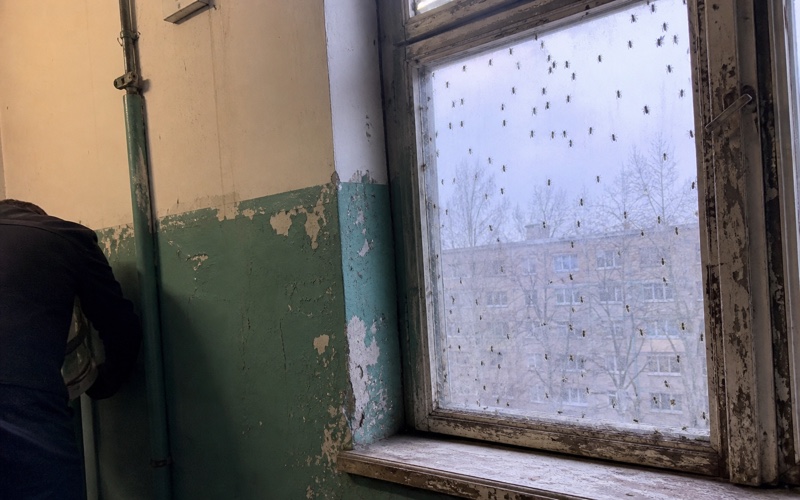
Flies gather on the glass, trying to reach the light.
Larvae in organic matter
Whitish, legless larvae in waste, food residue or damp organic material.
An unpleasant smell
Often indicates a hidden source - a dead animal in a void, a blocked drain or accumulated organic matter.
Small dark spots on surfaces
Fly specks on light-coloured walls, lampshades and window frames near the source.
Where the breeding site usually is
A female fly lays her eggs in damp organic matter, and in summer it takes only seven to ten days from egg to adult. A breeding site therefore produces a continuous supply of new insects.
The usual locations: refuse bins and the area around them, blocked drains and traps, food residue under equipment, damp organic matter in a cellar, a dead rodent or bird in a void or ventilation shaft, and compost or organic waste stored against the building.
The key point: if the breeding site is not removed, any treatment will hold for a few days at most.
How the treatment is carried out
First the source is located and removed. Then we carry out a residual treatment in the places where flies settle: window reveals, the area near the ceiling, ventilation openings and walls near light sources.
On food premises - restaurants, shops and production facilities - we use products suited to food areas and apply them as targeted dots, and we recommend mechanical measures alongside: UV units with glue boards and air curtains at entrances. Commercial work is quoted after a survey. See restaurants and for businesses.
For very large volumes in a warehouse or production space, ULV fogging knocks the adult population down quickly, but it is a knock-down measure and is only worth doing once the source has gone.
The dead animal problem
One specific scenario accounts for a surprising share of callouts, particularly in older buildings: a large fly hatch in a single room, with no visible food source and an odour that people often attribute to the drains.
This is usually a dead rodent or bird in a ceiling void, a ventilation duct or a wall cavity. The flies emerge, head for the light, and gather at the windows of that one room. The population declines on its own within two to three weeks once the carcass is dry, but the smell and the numbers make waiting unpleasant.
We can treat the room and reduce the numbers immediately, but locating and removing the carcass, which is usually a job for the building manager (apsaimniekotajs) or a builder, is what actually ends it. We do not carry out rodent control, so we will point you to the right trade rather than pretend otherwise.
Keeping flies out
- Insect mesh on opening windows, especially in the kitchen and any room facing a bin store.
- Lidded bins indoors, emptied daily in summer.
- Clean the area around external bins - the spillage around a container breeds more flies than the container itself.
- Keep drains and traps clear, since a blocked trap breeds both flies and gnats.
- Compost away from the building, with a lid and a proper carbon layer.
If the flies are small rather than house-sized, you are probably dealing with a different insect - see gnats and small flies.
Which fly you are dealing with
The species tells you where to look, so it is worth spending a minute on it before anything else.
- House flies - medium sized, grey, and constantly active. They breed in refuse, food waste and organic matter, so the source is usually within a few metres of the bins.
- Blowflies - large, metallic blue or green, slow and loud. These almost always mean dead animal material, which is why a sudden hatch of blowflies in one room points at a void or a duct.
- Cluster flies - slightly larger than a house fly, sluggish, and appearing in numbers at windows in autumn and on warm winter days. They do not breed indoors at all; they overwinter in lofts and wall cavities and are a sealing problem rather than a hygiene one.
- Small flies - anything much under 4 mm is a different insect entirely, covered on our gnats page.
Cluster flies in autumn
This is a specific and very common autumn complaint in houses and top-floor flats around Riga, and it is worth separating from a genuine infestation.
Cluster flies gather on sun-facing walls in September and October and work their way into lofts and wall cavities through small gaps to overwinter. They do not feed, breed or contaminate anything indoors. On a mild winter day the warmth wakes them and they appear at the windows of the top floor, which is when people call.
Because they are not breeding in the building, the answer is a residual treatment of the loft and the entry points plus sealing, rather than a hygiene programme. Treatment carried out in early autumn, before they settle in, gives much the best result.
Book a pest control visit
Fill in the form — we reply within 5 minutes. We work weekends and handle urgent callouts.