
Pest control in a warehouse
In a warehouse the challenge is scale: large volume, high racking, pallets and stock that must not be contaminated. That changes the method fundamentally compared with treating a flat.
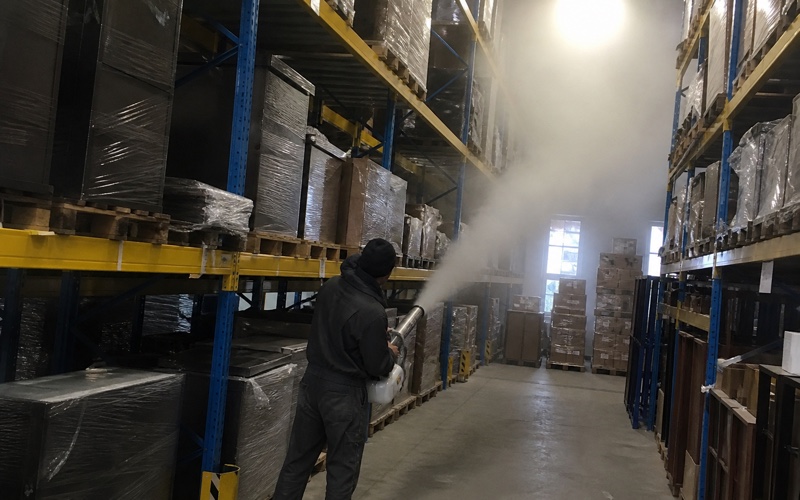
Why fogging is used in warehouses
Conventional spraying is not practical in a large volume with high racking, because it is physically impossible to reach every surface.
ULV fogging produces a cloud of very fine aerosol droplets that stays airborne and penetrates gaps, rack joints and other places nobody can reach with a lance. It treats a large volume in a short time.
Hot fogging produces an even finer mist with better penetration; cold fogging is used where the temperature regime matters, for example with temperature-sensitive stock.
Which pests turn up in warehouses
The species mix depends on what is stored. In dry goods and food storage, pantry moths and stored-product beetles dominate, usually arriving inside a delivery rather than flying in. In warm plant rooms and around equipment you get cockroaches. In damp corners and against outside walls, spiders, silverfish and flies around the loading bay.
We do not carry out rodent control or disinfection; our work here is insect control only.
Protecting stock and goods
Before the treatment we agree which zones and pallets are covered or moved out. In food and packaging areas we use only products approved for that use.
Work is normally scheduled when there is no goods movement — evening, night or weekend — so the logistics schedule is not affected. Where the whole warehouse cannot be cleared at once, we treat it in sections.
After fogging you need roughly 2 to 4 hours for airing and for the droplets to settle. We give you the exact figure before the work so shift patterns can be planned around it.
Monitoring as a permanent system
On a large site a single treatment is rarely enough. The more effective approach is a system of monitoring points: pheromone and glue traps laid out to a plan and checked on a schedule.
That catches problems early, before they reach the stock, and it localises them — often to a specific delivery, supplier or zone. It also documents the pest control process, which matters when a customer or auditor asks. See preventive treatment and monitoring.
How the treatment fits into logistics
In a warehouse the main cost is rarely the treatment itself, but any interruption to goods movement. So the work is planned around the logistics schedule rather than the other way round.
In practice that means treatment at night or at weekends when there is no loading and unloading; treating in sections where the whole warehouse cannot be cleared at once; and covering goods rather than removing them wherever that is acceptable.
We also want to know what is stored and where the stock came from. Pantry moths and stored-product beetles almost always arrive inside a delivery, so the useful question is not only where they are now but which pallet or supplier they came with. That is the difference between a treatment and a fix.
Treatment or monitoring: which you need
These are not the same service, and sites often ask for the wrong one.
- A treatment is the right answer when there is a visible, active problem: moths flying in the dry store, cockroaches around the plant room, a heavy fly population near the bays. It deals with what is there now.
- Monitoring is the right answer when the question is whether there is a problem at all, or where it is coming from. Traps laid to a plan and checked on a schedule answer both, and they answer them before the stock is affected.
Most warehouses that get this right run both: an initial treatment to clear the existing population, then monitoring to catch the next introduction early. Running only treatments means paying for the same job repeatedly; running only monitoring means watching a problem you never resolve.
Goods-in: where warehouse pest control actually starts
In a warehouse, insects are almost always brought in rather than bred on site. That makes goods-in the single control point where the problem is cheapest to stop, and it is where we put the first monitoring points.
- Check incoming consignments — particularly bulk goods, and anything from a supplier you have not used before.
- Unpack and remove cardboard immediately. Pallets and packaging are the main route in, and stored cardboard is harbourage in its own right.
- Keep pallets off the floor and clear of the walls so a visual inspection is actually possible.
- Rotate stock first-in, first-out so nothing stands long enough for a population to establish inside it.
- Isolate damaged packaging the moment it is found, rather than leaving it on the rack until someone has time.
- Clean between consignments. Product residue in the racking and structure is the commonest reason a treated warehouse is reinfested.
Recorded consistently, monitoring data at goods-in usually shows which supplier or which material the problem arrives with — which is worth more than any single treatment.
Book a pest control visit
Fill in the form — we reply within 5 minutes. We work weekends and handle urgent callouts.