
Pest control in a factory
In a factory, pest control is part of the quality system. The requirement is not simply the absence of insects but a demonstrable, documented process that stands up to an audit.
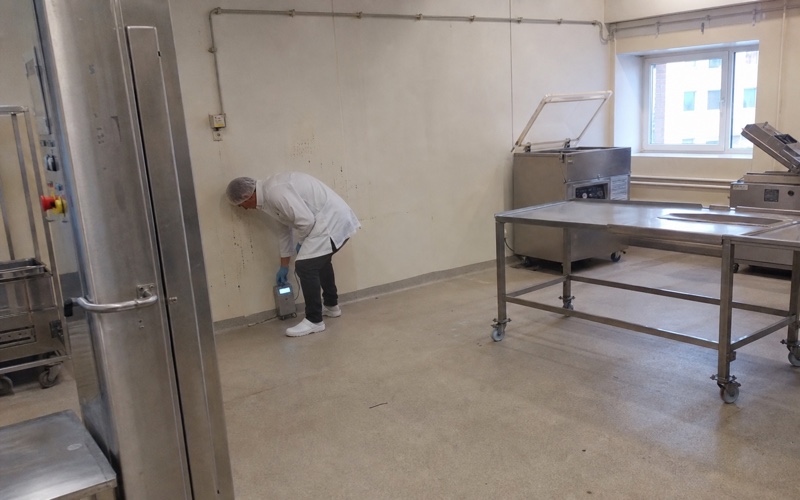
Treatment and the production schedule
Stopping production costs more than the treatment itself, so the work is planned around the production cycle: during scheduled maintenance, between shifts or at weekends.
For large halls, ULV fogging is effective, because it treats a large volume quickly and the space can be returned to use within a few hours.
Documentation and audits
In food and packaging production, pest control is examined during audits. What is needed is not just the fact that a treatment happened, but the system around it: a plan of monitoring points, a register of inspections, the findings and the actions taken.
For sites on regular servicing we prepare that documentation and keep it current, so nothing has to be reconstructed at the moment an auditor asks for it.
Monitoring as the foundation
In a factory, reacting to a visible problem already means the process has failed. The foundation is a system of monitoring points: pheromone and glue traps positioned to a plan, checked on a schedule, with the data recorded.
That shows the trend — where and when activity is rising — and lets you act before product is at risk. It also narrows the source, which in practice is often one incoming material or one warm zone near equipment.
What we do and do not cover
We carry out insect control. We do not carry out rodent control or disinfection, so if your audit scope requires those as well they need to be covered by a separate provider.
Within insect control the usual scope is production halls, raw material and finished goods storage, staff canteens and welfare areas, plant rooms, and the building perimeter and loading bays where insects come in.
Cost is set after a survey: area and number of zones, risk level, working hours, the amount of documentation and whether the work is one-off or scheduled.
Why a scheduled system beats reacting
On a production site, the cost of a pest incident is almost never the treatment. It is a held batch, a failed audit point, or a customer complaint traced back to your line.
That asymmetry is why production sites run scheduled systems rather than call somebody when they see something. A scheduled system produces three things a reactive one cannot: early detection while numbers are too low to see, a data trail showing the trend over months, and documentation that already exists at the moment an auditor asks.
It also localises the source. Trap data across a mapped site shows whether activity is concentrated at goods-in, in a warm zone near equipment or in the welfare areas, and that usually points at a specific material, supplier or housekeeping failure. A single reactive treatment tells you nothing at all about where the problem came from, which is why the same problem tends to come back.
Which pests are found on production sites
The mix depends on what is produced, but three groups cover most findings.
- Stored-product pests — moths and beetles in raw materials, almost always arriving inside an incoming delivery rather than migrating in. Pheromone monitoring identifies both the species and the batch.
- Crawling insects — cockroaches in warm plant rooms, around ovens and near welfare areas, and silverfish in damp voids.
- Flying insects — flies at loading bays and waste areas, worst in summer and consistently linked to how quickly waste leaves the site.
Welfare areas deserve a specific mention: staff canteens and locker rooms are frequently the actual source on otherwise well-run sites, because they are the one place food is present and cleaning standards are set by habit rather than by procedure.
Book a pest control visit
Fill in the form — we reply within 5 minutes. We work weekends and handle urgent callouts.