
Regular preventive pest control
Preventive treatment answers a different question from a one-off visit. It does not clear an existing problem; it stops one starting. For properties with constant exposure it costs less than repeated emergency call-outs.
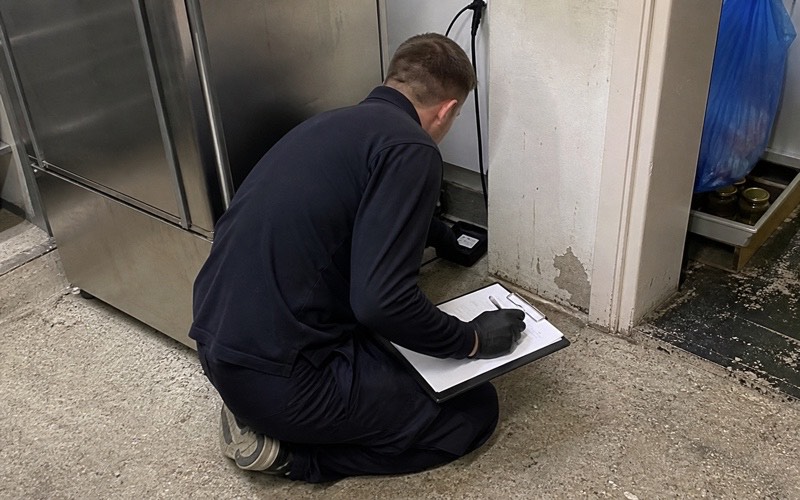
What regular servicing includes
A survey of the site and mapping of the risk zones, monitoring points placed to a plan, treatments and inspections on an agreed schedule, findings recorded, and documentation of the work carried out.
The essential difference from a one-off treatment: we do not only look at whether insects are present today, we follow the trend — where and when activity rises — and act before the problem becomes visible.
Monitoring is the important part
Monitoring points, meaning pheromone and glue traps positioned to a plan, detect a pest presence while the population is still small and nothing is visible to the eye.
The practical value: dealing with a problem at that stage is many times cheaper and faster than eliminating an established colony. Monitoring data also shows where the pests are arriving from — often a specific delivery, supplier or zone, which is information no reactive treatment ever produces.
Who it suits
- Food businesses. Restaurants, cafes, shops and production sites, where pest control forms part of the food safety system.
- Warehouses and logistics. Where goods arrive from many different suppliers.
- Hotels and hostels. Where the reputational risk is high and introductions are constant.
- Property managers. For regular treatment of shared areas in blocks of flats.
- Care settings. Where residents are vulnerable and reacting after the fact is disruptive.
It also suits houses for seasonal prevention — against wasps, ants and ticks before the season starts.
How the schedule is built
The schedule follows the risk rather than a template. After the survey we set the frequency of visits, which zones are inspected each time, where the monitoring points sit and what triggers an additional visit.
Food premises with constant deliveries generally need more frequent visits than an office. A site with a history of recurring problems needs closer monitoring than one with none. We would rather set a schedule that reflects the site than sell a fixed package that fits nobody.
Documentation and cost
For sites on regular servicing we prepare records of the work carried out and the monitoring data, which can be shown at inspections and audits.
Cost per visit is lower than for a one-off call-out, and overall regular servicing usually costs less than repeated emergency visits, because each emergency is a larger job than a scheduled one. We set the schedule and the scope after a survey — submit an enquiry and we will assess your specific situation.
What a monitoring system consists of
Monitoring is a system rather than a box of traps, and the parts matter.
- A site map. Numbered points marked on a plan, so a finding can be located exactly rather than described vaguely.
- Pheromone traps for stored-product pests such as pantry moths, which attract a specific species and therefore identify it.
- Glue traps for crawling insects, placed along walls and behind equipment where insects actually travel.
- A scheduled check of every point, with counts recorded rather than a simple yes or no.
- A record over time, which is what turns individual findings into a trend you can act on.
The counts are the point. One moth in a trap is noise; the same trap going from one to nine over three visits is a specific problem in a specific location, and that is actionable before anything is visible on a shelf.
How to start regular servicing
- 1
Enquiry.
Tell us the type of premises, the approximate area and whether there is a current problem. We reply within 5 minutes.
- 2
Survey.
A walk-through of the site, mapping risk zones and, where relevant, looking at goods flow and waste handling rather than only at rooms.
- 3
Proposal.
Visit frequency, the zones covered, where monitoring points sit, and what documentation is produced.
- 4
First visit.
Usually a treatment to clear anything currently active, plus placement of the monitoring points.
- 5
Scheduled visits.
Inspection, trap counts, treatment where indicated, and the record updated each time.
The schedule is reviewed rather than fixed forever. Sites with consistently clean trap data can move to less frequent visits; a site with a recurring hotspot needs the opposite.
Book a pest control visit
Fill in the form — we reply within 5 minutes. We work weekends and handle urgent callouts.