
Pantry moth treatment
Pantry moths almost always come into a home inside a product you have bought - flour, cereal, nuts or pet food. The moths flying around are the breeding stage; the actual damage is done by larvae inside the packaging.
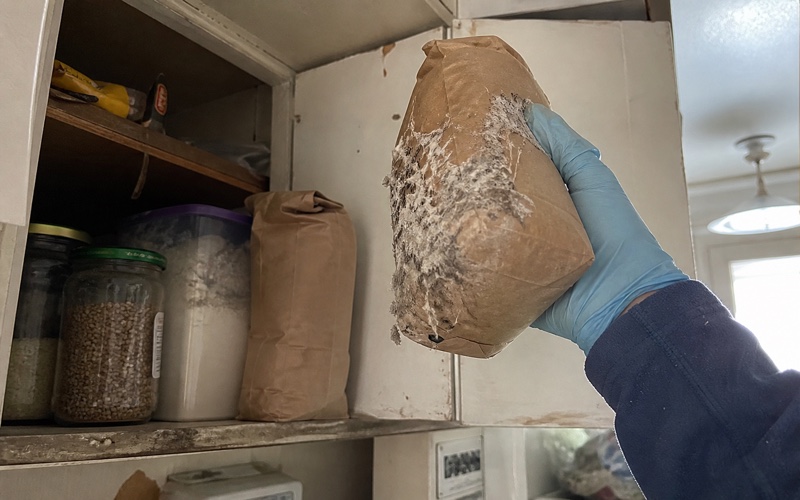
How to spot it
Small moths in the kitchen
Greyish-brown moths 8-10 mm long, flying slowly along the tops of cupboards and the ceiling, mostly in the evening.
Webbing in packets
Silky threads and clumped grains in packets of cereal, flour or nuts.
Larvae in the food
Whitish caterpillars with a dark head inside the product or crawling up the cupboard walls.
Pupae in cupboard corners
Before pupating the larvae crawl away from the food and pupate in cupboard corners, under shelf edges and by the ceiling trim.
Clumped, grainy cereal
Grain or flour that has gone sticky and lumpy for no obvious reason is often already infested.
Where to look for the source
Treatment without removing the source achieves nothing. What needs checking: flour, cereals, pasta, rice, pulses, nuts, dried fruit, seeds, spices, dry breakfast cereal, and also dry pet food and bird seed.
Larvae can chew through thin polythene and cardboard, so an unopened packet is no guarantee. Also check cupboard corners, the undersides of shelves and the strip where the units meet the ceiling, which is where pupae concentrate.
One habit makes the search much quicker: take everything out of the cupboard rather than looking into it. Infested packets are usually at the back, and the pupae are on surfaces you cannot see with the shelf full.
How the treatment works
First we identify and dispose of every infested product. Then the cupboards are emptied and we treat the specific places where the insect actually lives: cupboard seams, shelf joints, corners and the backs of units.
In areas where food is prepared we use products suited to that setting and apply them as targeted dots rather than spraying across worktops. This is a point people ask about often, and rightly - a kitchen treatment that sprays surfaces indiscriminately has been done badly.
Pheromone traps may also be placed. They do not eliminate a population, but they let you check whether the treatment was complete and catch a fresh introduction early, which is genuinely useful in the months afterwards.
The life cycle, and why it explains the timing
A female lays up to 300 eggs directly on or near a food source. The larvae hatch within about a week and feed for four to six weeks, spinning silk as they go - the webbing is the clearest single sign of an active infestation.
The larvae then leave the food entirely and travel some distance to pupate, often several metres. This is the detail that catches people out: you throw away the infested flour, and two weeks later moths appear anyway, because the pupae were never in the flour to begin with. They were in the corner of the cupboard, behind the shelf trim, or in the gap above the units.
At room temperature the full cycle runs six to eight weeks, so a second wave two months after the first is not a new infestation - it is the same one.
How to prevent it coming back
- Store dry goods in airtight glass or thick plastic containers, not in the original paper or film packaging.
- Check new products after buying, especially if the packaging is damaged.
- Do not store large quantities for long periods; rotate your stock and use the oldest first.
- Wipe out cupboard corners and shelf gaps regularly, since that is where pupae sit.
- Freeze suspect items for 72 hours after buying - this kills eggs in flour and grains without affecting the food.
These are ordinary measures, but they are the difference between a one-off event and a recurring annual problem.
Pantry moths in shops and warehouses
In commercial settings the same insect becomes a different problem, because the source is often a whole pallet rather than a single packet, and the pupae spread into the structure of the building.
Here we combine stock inspection, targeted treatment of racking, wall and ceiling junctions, and a pheromone monitoring grid that shows where the population is concentrated. Commercial work is quoted after a survey. See warehouses, shops and pest control for businesses.
How to check a cupboard properly
Most repeat infestations happen because the first inspection was too quick. A thorough check takes half an hour and is worth doing once, properly.
- 1
Empty the cupboard completely.
Everything out onto the worktop, including tins and jars, so you can see the shelf surfaces.
- 2
Check every dry good individually.
Open packets, tip a little into a light-coloured bowl and look for webbing, clumping and movement. Include spices, dried fruit, nuts, seeds, pet food and bird seed.
- 3
Look at the corners and the shelf undersides.
Pupae sit in the angles, under shelf lips and behind the trim where the units meet the ceiling.
- 4
Check the door hinges and runners
and the gap between the units and the wall.
- 5
Vacuum the empty cupboard
including the corners, then take the bag straight outside.
Anything you are unsure about but do not want to throw away can go in the freezer for 72 hours, which kills every stage without affecting the food.
Why the problem comes back a month later
This is the most common follow-up question we get, and the answer is almost always the same: the source was found, but the pupae were not.
Larvae leave the food before pupating and can travel several metres. They end up in the corner of a cupboard, in the gap above the units, behind a skirting board or inside a light fitting. Throwing out the infested flour removes the food but leaves an entire generation waiting to emerge.
The other recurring cause is a second, unnoticed source in the same kitchen - very often dry pet food or bird seed, which people do not think of as food. Where a treatment has to be repeated, this is what we look for first.
If moths reappear six to eight weeks after treatment, that is the length of one full life cycle. It points to missed pupae rather than a fresh introduction from a shop.
Prices and what to expect from a visit
A kitchen treatment in a flat is from 55 euros for one room, 60 euros for two and 65 euros for three, and a house is from 120 euros. Where a repeat treatment is needed it is from 60 euros. Shops, restaurants and warehouses are quoted after a survey.
A visit takes around an hour for a normal kitchen. We ask that the cupboards are emptied beforehand where possible, because the treatment goes onto the shelf surfaces, joints and corners that a full cupboard hides. If that is not practical, tell us and we will work around it.
Afterwards, do not wipe out the treated cupboard interiors for two to three weeks - the residual layer is what deals with the pupae that emerge after the visit. Fresh food can go back in immediately in sealed containers. See after treatment.
Book a pest control visit
Fill in the form — we reply within 5 minutes. We work weekends and handle urgent callouts.