
Pest control in a shop
A shop has to reconcile two demands: the safety of stock and food, and continuity of trading. The work is planned so that neither has to be sacrificed.
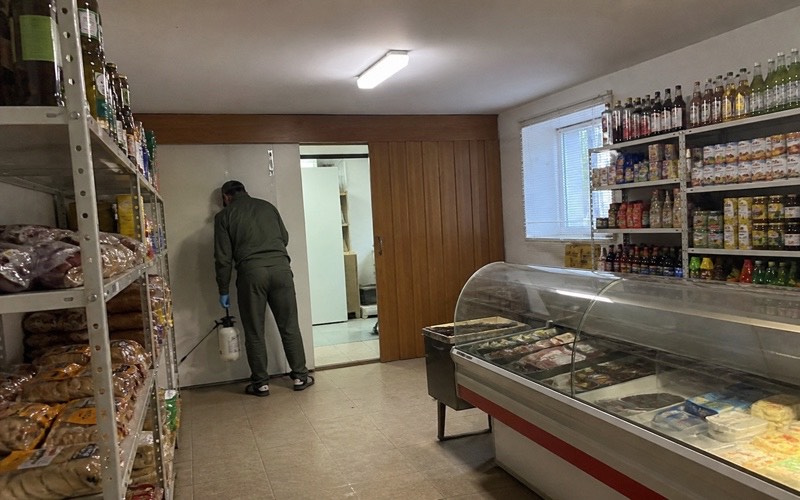
Shop floor and stockroom are two different problems
On the shop floor the main risk is visibility: an insect on a shelf or at the till instantly becomes a customer’s experience and, often, a review.
In the stockroom the problem is usually different — pantry moths and stored-product pests in pallets and loose goods, plus cockroaches in the warm zones around refrigeration equipment.
So we treat the two areas differently: the shop floor discreetly and to specific points, the stockroom more broadly and with monitoring points in place.
How stock is protected
Before the treatment we agree which zones are covered. In food areas we use only products approved for that purpose and apply them to specific points rather than spraying.
The work is done after closing so the product dries before opening and no customer comes into contact with it.
Goods-in is the main entry route
The most common way insects enter a shop is with the delivery: pallets, cardboard cases and loose products from a supplier.
That makes the goods-in area the main control point. Monitoring traps placed there catch a problem before it spreads into the stockroom and onto the shop floor, and they usually identify which supplier or product line it arrived with.
- Inspect incoming pallets before they go into storage, especially dry goods and pet food.
- Break down cardboard quickly. Stored cardboard is both harbourage and food.
- Rotate stock properly. Forgotten stock at the back of a rack is where moth infestations start.
- Keep the bin area away from the doors and clean rather than just emptied.
Cost and regular servicing
Shop treatments are quoted after a survey. Floor area, the number of zones, the risk level, whether night work is needed and the amount of documentation required all shape the figure.
For retail with constant deliveries, regular servicing with monitoring generally costs less than repeated emergency call-outs, and it prevents the version of the problem where the person who spots the insect is a customer.
Which pests turn up in retail
What you find depends heavily on what you sell.
- Pantry moths. Dry goods, flour, cereals, nuts, pet food and birdseed. They arrive inside product and spread through the aisle.
- Stored-product beetles. Same aisles, often noticed later than moths because they do not fly around the shelf.
- Cockroaches. Warm zones around refrigeration compressors, bakery ovens and plant rooms.
- Flies. Goods-in doors, bin areas and fresh produce sections in summer.
- Fruit flies. Fresh produce, damaged fruit left in a display, and drains.
Naming the aisle and the product in your enquiry usually narrows the species before we arrive, which shortens the survey considerably.
How the work is scheduled
Retail work is planned around trading rather than around us.
The default is after closing, so the product dries overnight and no customer comes into contact with it. Where a shop trades late and opens early, we treat in sections across two nights rather than rushing a single pass, because a rushed treatment around loaded shelving is the version that fails.
In the stockroom we prefer to work when there is no goods movement. That is partly practical — pallets need to be accessible — and partly because goods-in is where we want to place monitoring, and that is easier to plan when the area is quiet.
Tell us your delivery days in the enquiry. Treating a dry store the day before a large delivery arrives, rather than the day after, is a straightforwardly better use of the visit.
What we need from you before the visit
- Access to the stockroom and the plant areas, including behind refrigeration units.
- Agreement on covering. Which zones are covered, which are cleared, and which are not to be treated at all.
- A named contact on site, present at the start, who can authorise decisions about moving stock.
- Recent history. What you have seen, where and for how long, plus anything you have already tried.
That last point matters more than it sounds. If the aisle has been sprayed with a shop product recently, that changes what will work and we would rather know before we start than after.
Trading hours and when the work happens
In retail the constraint is rarely the treatment itself — it is that the shop floor has to be sellable the next morning. So we work after closing, and the plan is built around what cannot be exposed to product contact.
- Food retail. Open product and unpackaged goods are covered or removed before we start, and surfaces that customers or staff touch are wiped down afterwards. In food areas we use only products permitted there, placed in targeted spots rather than sprayed across the space.
- Non-food retail. Textiles and clothing stock are the sensitive part — clothes moths in particular. See clothes moth treatment. Rails and shelving are treated at the joints and undersides, where the larvae actually sit.
- Shopping-centre units. If your unit is inside a centre, the neighbouring units and shared service corridors matter as much as your own floor space. Insects move along shared ceiling voids and service ducts, so a unit treated in isolation can be re-colonised from next door. Where that is the situation we say so, and treatment of the unit is combined with barrier work at the boundaries.
Most treatments take under two hours in a unit of ordinary size, and the shop opens as normal the following morning.
Book a pest control visit
Fill in the form — we reply within 5 minutes. We work weekends and handle urgent callouts.