
Cold and hot ULV fogging
Fogging creates a cloud of very fine aerosol droplets that stays airborne and penetrates places no lance can physically reach. The method is designed for large volumes.
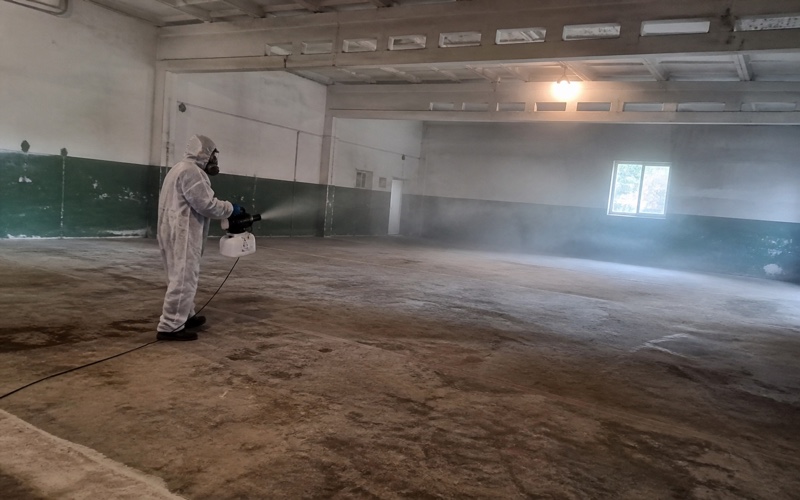
Cold and hot fog: the difference
- Cold fogging (ULV) generates the aerosol mechanically, without heat. Droplet size is roughly 5 to 50 microns. It suits spaces holding temperature-sensitive goods or equipment, and it can be used across a wider range of sites.
- Hot fogging vaporises the product to create an even finer fog, around 1 to 15 microns. It penetrates deeper into structures and stays airborne longer, so it is more effective in very large volumes and structurally complex spaces. The visible fog also lets us check coverage by eye.
How a fogging visit runs
- 1
Survey and agreement.
We establish the volume, what is stored and which zones are covered or cleared.
- 2
Sealing the space.
Doors, ventilation and openings are closed so the fog stays where it is needed.
- 3
Fogging.
Nobody may be inside during the application; the equipment is operated from a controlled position.
- 4
Contact time.
The fog is left to settle and reach the gaps.
- 5
Airing.
Ventilation is restarted and the droplets settle out, usually 2 to 4 hours in total.
- 6
Handover.
The space is checked and returned to use, and we record what was done.
Where this method fits
Fogging is intended for spaces where surface treatment is impractical: warehouses with high racking, production halls, hangars, plant rooms, large basements and grain stores.
It is not normally used in a flat. There, targeted surface treatment or a gel bait gives a better and longer-lasting result, and fogging a small room simply disperses more product for no additional effect.
What to bear in mind, and when it does not fit
Nobody may be in the space during the treatment. Afterwards, airing and droplet settling take roughly 2 to 4 hours, depending on the space and the product. Before the work we agree on covering or removing goods and equipment; in food premises we use only products approved for that use.
The main weakness of fogging is a comparatively short residual effect: it is excellent at killing what is in the space at the time of treatment, but it protects less well against insects arriving later. For lasting protection it is usually combined with a residual surface treatment at the critical points.
It is also the wrong choice where a pest hides deep inside timber or structure — woodworm and bedbugs in deep crevices are not solved by fog — and where there is open product or sensitive equipment that cannot be covered.
What to expect after fogging
Fogging looks dramatic, which leads to some predictable questions afterwards.
- Airing and settling take 2 to 4 hours. Nobody should re-enter before that, and we confirm the figure for your space before the work rather than quoting a rule of thumb.
- A fine deposit may be visible on smooth horizontal surfaces. Work surfaces and anything that contacts food or product are cleaned before the space is handed back.
- You will find dead insects for several days. That is expected. Insects that were deep in structure at the time of treatment emerge and die afterwards.
- Activity may not stop immediately. If a species is breeding inside the structure, fogging kills what is airborne and exposed, but the residual effect is short. Where activity continues past a week, the answer is usually a residual surface treatment at the critical points rather than fogging again.
Where fogging is used most often
Four settings account for most of the fogging we do, and they have the same shape: large volume, complex structure and no practical way to treat every surface by hand.
- Warehouses with high racking, where the upper levels are unreachable with a lance and the gaps between rack joints are exactly where insects sit.
- Production halls, treated during a maintenance window, where the requirement is to clear the whole volume quickly and return it to use within hours.
- Grain and dry goods stores, against stored-product pests, using products approved for those areas.
- Large basements and plant rooms, where structure is complicated, access is poor and surface treatment would miss most of the harbourage.
What these have in common is that fogging is the only method that reaches the whole volume in a single pass. In a flat, none of that applies, which is why we do not use it there.
Book a pest control visit
Fill in the form — we reply within 5 minutes. We work weekends and handle urgent callouts.