
Woodworm treatment in timber structures
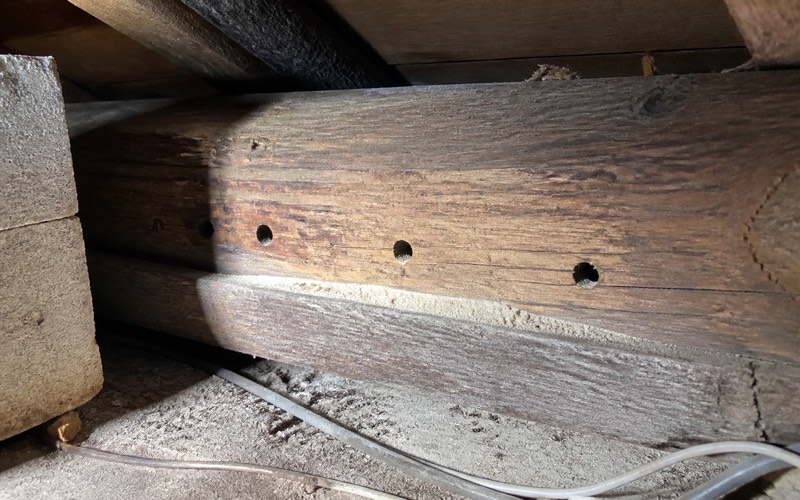
Woodboring beetle larvae develop inside timber for years, and the holes you can see are where the adult beetles emerged. Visible damage therefore always means the process has been running for a long time.
How to spot it
Round holes
One to three millimetres across, in beams, floorboards, furniture or timber trim.
Powdery dust
Pale, fine wood dust below the holes or on the floor beneath.
A quiet rasping
In a silent room you can sometimes hear a steady gnawing inside the timber.
Soft timber
Where the infestation is long-standing the wood becomes porous and easily pressed in.
Weak or crumbling edges
Beam ends near damp masonry crumble first, since that is where moisture is highest.
Why woodworm is a serious problem
Unlike most indoor insects, woodboring beetles damage the structure of the building. A long-standing infestation in roof timbers, floor structures or load-bearing elements reduces their capacity to carry load.
The larva develops inside the timber for several years, and throughout that time the damage grows while remaining almost invisible from outside. The earlier the problem is found, the smaller the eventual repair.
Where the damage affects load-bearing elements, a structural assessment is needed alongside the treatment. Treatment kills the insects; it does not restore timber that is already damaged.
How the treatment is carried out
Woodworm treatment differs from ordinary indoor pest control: the product has to reach inside the timber where the larvae are, not just sit on the surface.
Depending on the situation we use deep impregnation with a combined preservative and insecticide, injection of the product into the exit holes, and surface treatment as prevention. Individual pieces of furniture can be treated with heat, which kills every stage without chemicals.
Preventing damp is equally important: woodworm develops considerably faster in wet timber, so roof leaks and poor loft ventilation accelerate the damage. Fixing those is part of the solution, not an optional extra.
Is the infestation active?
This is the first question worth answering, because a lot of old timber carries historic holes from an infestation that finished decades ago.
The signs of an active infestation are fresh, pale wood dust below the holes, and holes with sharp, clean edges. Old holes are dark inside, weathered at the edges, and have no fresh dust beneath them. A simple test is to clean the area thoroughly, cover the floor beneath with paper, and check again after a few weeks: new dust means live larvae.
Emergence happens mainly from May to August, so fresh holes and dust appearing in early summer are the clearest evidence.
Where it typically occurs around Riga
The buildings most often affected are wooden houses in districts such as Agenskalns, Kalnciema iela and Torņakalns, older summer houses on the coast, and the roof structures of pre-war buildings. Untreated softwood in an unheated, poorly ventilated loft is the classic environment.
Furniture is the other common case, and it is worth checking any second-hand item before bringing it into the house - antique furniture bought at a market is a routine way an infestation arrives in an otherwise clean building. See summer houses and houses.
Which beetle is in the timber
Three species account for nearly all the damage found in buildings here, and the difference matters because the seriousness varies enormously.
- Common furniture beetle. Exit holes 1-2 mm, in softwood and plywood, in furniture, floorboards and roof timbers. By far the most common, and usually treatable without structural work if caught reasonably early.
- House longhorn beetle. Oval exit holes 6-10 mm, in softwood roof timbers only. Much rarer but far more serious, because the larvae hollow out the interior of a beam while leaving the surface almost intact.
- Deathwatch beetle. Holes around 3 mm, in old damp hardwood, mainly oak in historic buildings. Associated with damp and fungal decay, so the damp has to be dealt with as part of the fix.
Hole size and the timber species usually settle the identification, and we assess this on site before deciding on the method.
Damp is what drives it
Wood boring beetles need a moisture content in the timber of roughly twelve per cent or more. Genuinely dry, well-ventilated timber is a poor host, which is why the same roof structure can be heavily attacked at one end and untouched at the other.
The places where damp and timber meet are predictable: beam ends built into an external wall, timber below a roof leak or a failed flashing, floor joists over an unventilated crawl space, and a loft where the ventilation has been blocked by added insulation.
The practical conclusion: a treatment that is not accompanied by fixing the source of the damp will slow the problem rather than end it. Where we see this, we say so before the work rather than after.
Book a pest control visit
Fill in the form — we reply within 5 minutes. We work weekends and handle urgent callouts.