
Bed bugs in the bed - how to get rid of them
Bed bugs (Cimex lectularius) live exactly where you sleep - in mattress seams, in the gaps of the bed frame and behind the headboard. You will rarely see them during the day: feeding happens at night, most often between three and five in the morning.
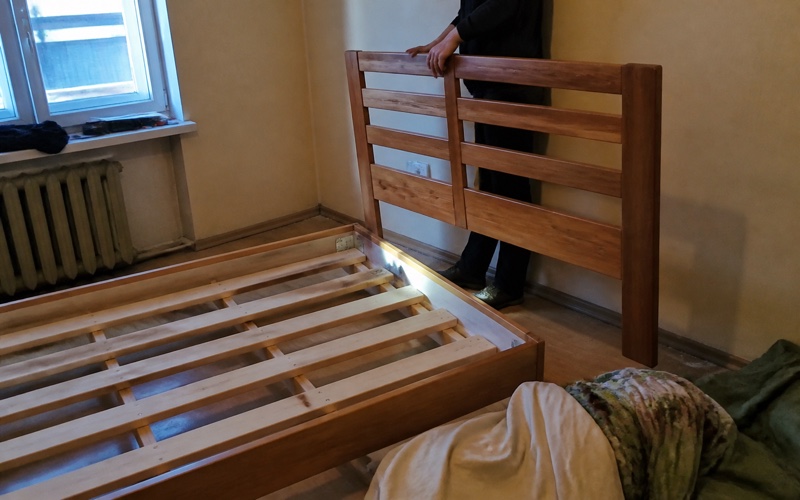
How to spot it
Bites noticed in the morning
You do not feel the bite at night - bedbug saliva contains a mild anaesthetic. The marks are only noticed after waking.
Marks on the sheet
Reddish-brown dots left when a fed bug is crushed as you move in your sleep.
Specks along mattress seams
Dark droppings concentrate along the piped edge seams of the mattress and at frame joints.
Bugs in the frame joints
Check the joints and screw holes of a wooden bed frame - that is where they hide most often.
Live bugs behind the headboard
Pull the headboard away from the wall and look at the fixings and the back panel.
What a bed bug actually looks like
A bed bug is a wingless insect with a flat, oval body. An adult is 4-7 mm long - roughly the size of an apple pip - and reddish-brown. After feeding the body swells, lengthens and darkens to almost deep red.
Nymphs are smaller and paler, almost translucent, which makes them hard to spot on light bedding. Eggs are about 1 mm long, whitish, and glued to the surface; without magnification they look like specks of dust.
One simple check settles most misidentifications: bed bugs have no wings and they do not jump. If the insect leaps, it is almost certainly a flea; if it flies, it is not a bed bug. See how to identify bedbugs.
Why the bed specifically
Bed bugs pick a hiding place as close as possible to the food source while staying invisible during the day. A bed is ideal: dark, narrow gaps a few centimetres from a sleeping body.
The places we typically find them are mattress seams and labels, bed frame joints and screw holes, the back of the headboard, the seams of a bedside table, the skirting board along the side of the bed, and even the socket next to the bed.
Where the infestation has been running a long time, they spread further - to the sofa, armchairs and soft furnishings in other rooms. That spread is the clearest sign that the problem is no longer only a bed problem.
Why the eggs are the real problem
A female lays continuously, and the eggs are tough: glued to the surface and protected by a shell most insecticides cannot get through. Every six to ten days a new batch of nymphs hatches.
That is precisely why a single spray almost never solves anything. The adults die, a week later a new generation appears, and it looks as though the treatment did nothing.
There are two workable answers: a product with a long residual action that stays live until the nymphs hatch, or heat treatment, which destroys the eggs immediately.
Heat treatment for individual items
It is not always necessary to treat a whole room. If the infestation is localised in one mattress, a sofa, luggage or clothing, those items can be processed inside a heat chamber: the temperature is raised to around 60 degrees and held until every stage, eggs included, is dead.
The advantages are that no chemicals are involved and nothing has to be thrown away. It often saves furniture that would otherwise go to the tip. Full detail is on the heat treatment page.
For rented flats and guest accommodation there is a second advantage that matters more than people expect: once the room has cooled it is usable straight away. There is no airing-out period and no chemical smell for the next tenant or guest to notice.
What to do right now, before we arrive
- Strip the bedding and put it straight into the washing machine at 60 degrees or above.
- Do not move the mattress or furniture into other rooms. That is the single most common way people spread an infestation through a whole flat.
- Do not sleep in another room. Bedbugs follow the carbon dioxide and will colonise the new sleeping place within days.
- Vacuum thoroughly along mattress seams and frame gaps, then take the bag out of the flat immediately.
- Do not spray anything yourself in the days before treatment - it drives the bugs deeper into the structure and makes the job harder.
The full list is in how to prepare for treatment.
Protecting the bed afterwards
Once the colony is gone, the job becomes preventing a repeat. A few permanent changes in the bedroom do most of the work.
- Zipped mattress and pillow encasements. A tight cover seals the mattress completely: any bugs left inside cannot get out and eventually die, and new ones cannot get in and settle in the seams. It is the only mechanical measure that genuinely works long term.
- Keep the bed off the wall. A small gap removes the easiest route from wall cracks onto the bed.
- Do not let bedding touch the floor. A sheet or duvet reaching the floor is a bridge that lets bugs bypass the frame entirely.
- Store nothing under the bed. Boxes, bags and textiles underneath make perfect secondary harbourages.
- Check monthly. Two minutes with a torch along the mattress seams and frame joints catches a new problem while it is still small.
Bed bugs in rented flats and hotels
In properties with a fast turnover of people, the question is not only biological but a matter of time: how quickly the room goes back into use.
Here heat treatment is particularly efficient. Because the heat also destroys eggs, there is often no need to take the room out of service a second time two weeks later. Individual items - mattresses, sofas, luggage - can be treated in the chamber without interrupting the rest of the premises.
If you rent, tell your landlord in writing as soon as you suspect bedbugs, and do not delay treatment while responsibility is being discussed - the colony grows every week. See pests in a rented flat and bedbugs after travel.
Why DIY almost never finishes the job
Search for what repels bed bugs and you will find essential oils, lavender, vinegar and diatomaceous earth. These work mainly as repellents: they keep bugs away from one spot for a while, but they do not destroy a colony and have no effect on eggs.
The usual result is that the bugs relocate within the same flat - from the bed to the sofa, or into the next room. It looks as though the problem is shrinking when in fact it is spreading, and the eventual treatment has to cover more rooms than it would have done.
Shop-bought insecticides run into two limits. An aerosol only acts where it physically lands, and it does not reach deep into frame joints or behind skirting boards. And many bedbug populations have developed resistance to pyrethroids, which are the basis of most retail products.
The genuinely useful things you can do yourself are washing at 60 degrees and thorough vacuuming. Both physically destroy part of the population, eggs included, and both are worth doing before and after a professional treatment. See why shop products fail.
Book a pest control visit
Fill in the form — we reply within 5 minutes. We work weekends and handle urgent callouts.