
Bedbug bites: how to recognise them
Bedbug bites are the most common way people first find out they have an infestation, because the bedbugs themselves are hard to spot during the day. The characteristic feature is the arrangement: often three bites in a line, sometimes called breakfast, lunch and dinner.
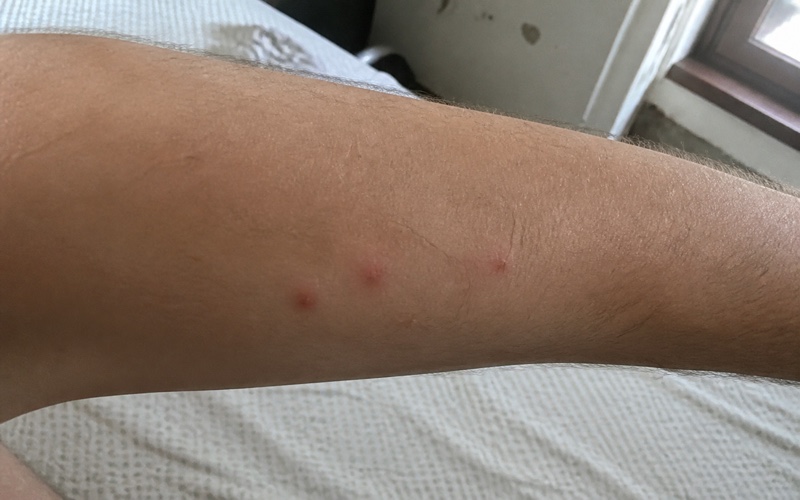
What a bedbug bite looks like
A red, slightly raised spot with a pronounced itch. The bites are often arranged in a straight line or a small cluster, because the bedbug moves across the skin and feeds several times.
They appear on the parts of the body left uncovered at night: arms, shoulders, neck, face, legs. The reaction is highly individual — some people develop marked swellings, while roughly a third show no visible reaction at all.
This matters. If one member of the household has bites and another does not, it does not mean the bedbugs are only biting one person. The other may simply have no skin reaction.
Why you feel nothing at the time
Bedbug saliva contains a mild anaesthetic as well as a substance that prevents blood clotting. That is why nothing is felt during feeding and nobody wakes up.
The itch and redness develop later, usually after a few hours or the following day. This is exactly why the bites are almost always noticed in the morning.
Bedbugs feed at night, most often between about 3 and 5 in the morning, when human sleep is deepest.
The delay also explains a common confusion: people associate the bites with wherever they were the previous evening, rather than with their own bed.
The variation is worth spelling out, because bedbug bites are one of the few pest symptoms where two people sharing a bed can experience completely opposite things.
- No reaction at all. Roughly a third of adults. The bite still happens; the skin simply does not respond visibly.
- A delayed reaction. Marks appearing two or three days later, which makes the timing hard to trace.
- An increasing reaction. Repeated exposure often sensitises people, so someone who had no marks for the first fortnight starts reacting strongly.
- A strong reaction. Large welts and considerable swelling, disproportionate to the size of the bite.
Older people and small children often react less visibly, which is why an elderly relative can have an established infestation with almost no complaint about bites.
The practical consequence is that the number of bites is a poor guide to the size of the problem. A flat with heavy bites and one with almost none can hold populations of similar size. What tells you the scale is the physical evidence in the bed, not the skin.
It also means that a single household member reporting bites should not be dismissed. In a shared flat or a family, one reactive person is often the only early warning the others get.
What bedbug bites are mistaken for
Most often for an allergy, mosquito bites or hives. These observations help separate them:
- Regularity. Bedbug bites appear every morning, or nearly every morning, rather than once.
- Connection to a place. The bites happen at home but not after a night elsewhere, or the reverse.
- The line arrangement. Mosquitoes and allergies do not produce that pattern.
The only reliable confirmation is physical evidence in the bed: dark spots in the mattress seams, blood spots on the sheet, shed skins. See how to identify bedbugs.
How long the bites last
Healing time is individual but usually falls in a predictable range.
| Stage | Typically |
|---|---|
| Redness appears | A few hours to 2 days after the bite |
| Peak itching | Days 2-3 |
| Fading | Days 5-14 |
| Scratched bites | Longer, and may leave marks |
The main practical advice is not to scratch. Scratched bites can become infected, and it is the infection rather than the bite itself that causes the more serious problems.
We are not a medical service and we do not give treatment or medication advice. If the itching is severe, the reaction spreads well beyond the bites, or anything does not settle, see a doctor.
Why bites continue after a treatment
A question that comes up often: the treatment has been done, but there is a new bite in the morning. Does that mean it did not work?
Usually not, and there are three ordinary explanations.
- The bite is older than you think. Reactions can be delayed by two or three days, so a mark appearing on day two may be from before the treatment.
- Individuals hatching from eggs. Expected in the first two weeks. They pick up the residual layer, which is why a second treatment is often scheduled at 10-14 days.
- An untreated zone. A sofa in another room, a suitcase, a chair that was never mentioned.
New bites still appearing after 3-4 weeks are a different matter — see why pests come back.
A useful way to track it is to photograph the bites with the date, or simply note each morning whether there were new ones. Memory is unreliable here, and an honest record of the first fortnight tells us far more than an impression does. It also distinguishes a genuinely declining count from the feeling that nothing is changing.
What to do next
Bites are a symptom. While there is a population in the property they will keep appearing, whatever you put on your skin. The first step is to check the bed: the mattress seams, the frame joints and the back of the headboard.
If the signs are confirmed, do not move the bed to another room and do not go and sleep somewhere else — the bedbugs follow the person and colonise the new place as well, while the old one keeps its population. See bedbug treatment and bed bugs in the bed.
Two other things not to do. Do not throw the mattress out before anyone has looked at it: in most cases it can be treated, and a new mattress in an untreated room is colonised within weeks. And do not start with shop aerosols, which do not reach the eggs and push the bedbugs into rooms that were previously clear.
What does help immediately is stripping the bed and putting everything into a 60 °C wash, then keeping it sealed until the room has been treated. See how to prepare your property.
Book a pest control visit
Fill in the form — we reply within 5 minutes. We work weekends and handle urgent callouts.