
How to identify bedbugs
Bedbugs are hard to see during the day, so an infestation is identified by the traces they leave. This page is a practical checklist you can work through yourself in about fifteen minutes.
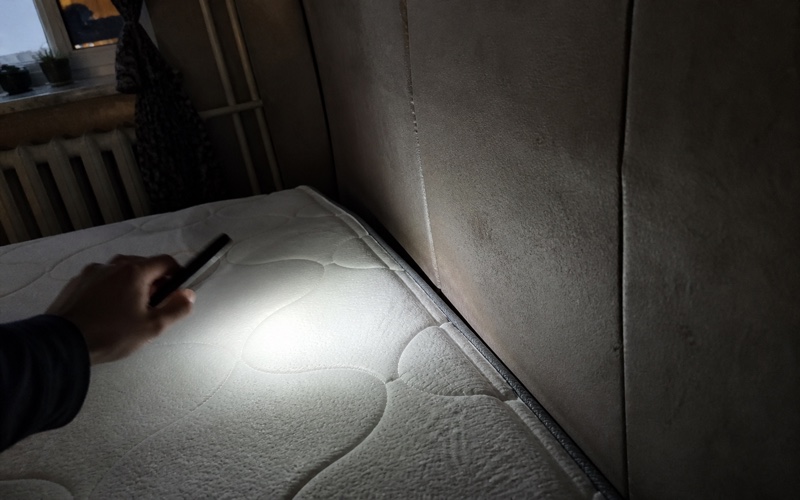
Where to look, in order
- 1
Mattress seams and labels.
Strip the bedding and inspect the whole perimeter of the mattress, particularly the inside of the seams.
- 2
Bed frame joints.
Screw holes, the joints between slats, gaps in the wood — the most common hiding place of all.
- 3
Behind the headboard.
Pull it away from the wall if you can. In many flats this is where the largest concentration is.
- 4
The bedside table
— seams, drawer runners, the underside.
- 5
Skirting boards along the bed
and around the sockets.
- 6
Upholstered furniture in the same room
— sofa, armchair.
Use a torch and, if you have one, a magnifying glass. Bedbugs hide in narrow gaps, so the point is to look into things rather than at them.
Exactly what to look for
- Dark specks — black, about the size of a fine pen mark. These are droppings and they bleed slightly into light fabric, which is a useful distinguishing feature.
- Blood spots — rust-red on the sheet or mattress, from a crushed bedbug.
- Shed skins — translucent, empty shells in the shape of a bedbug. There are five nymphal stages, so an established infestation leaves many.
- Eggs — whitish, about 1 mm, glued into gaps; hard to see without magnification.
- Live bedbugs — flat, oval, 4-7 mm, brown; swollen and darker after feeding.
One confirmed sign is enough. You do not need to find a live bedbug to conclude there is a problem.
A quick test for the dark specks: a damp white cloth pressed on one will smear rust-brown, because it is digested blood. Ordinary dirt will not do that.
What bedbugs are confused with
Most often with carpet beetle larvae (hairy and elongated) and with shield bugs, which fly in through the window in autumn — those are larger, distinctly shield-shaped and do not live in beds.
If what you have found is larger than 7 mm, has wings, or is hairy, it is not a bedbug.
Bedbug nymphs are the opposite problem: they are small, pale and easy to miss entirely. A first-stage nymph is around 1 mm and nearly translucent until it has fed.
Two other frequent confusions are worth naming. Booklice are tiny, pale and fast-moving, appear in damp flats and do not bite anyone; they indicate a humidity problem, not a bedbug one. Spider beetles are round-bodied, shiny and long-legged, and are usually found near stored food rather than in a bed.
The single most reliable discriminator remains the combination of shape and place: a flat, oval, wingless, hairless insect of 4-7 mm found in or immediately beside a bed. Any one of those features on its own proves little; all four together are close to conclusive.
And if your check turns something up, keep it. It speeds up identification considerably and removes the need to guess.
- Sticky tape. Press an insect this small under clear tape on white paper. Easier than a jar and it does not damage it.
- A photo with something for scale. A coin or a ruler edge. Size is the single most useful piece of information.
- Note where it was found. Mattress seam, skirting board, wardrobe — it changes the assessment.
Send the details in the enquiry form and we can often confirm the species before anyone travels.
If you find nothing but the bites continue
If there are bites but no physical signs, do not rush to book a treatment. A few things are worth eliminating first.
- Look again with a torch, at night. Bedbugs are most active between about 3 and 5 in the morning, and a check at 2 a.m. finds what a daytime check misses.
- Check the sofa, not just the bed. If anyone regularly falls asleep on it, that is where they will be.
- Consider fleas. Bites below the knee point to fleas rather than bedbugs.
- Consider that it may not be insects. If nothing is found anywhere, a doctor is a more useful next step than a treatment.
A practical trick if you want to settle it without waiting: put a plain white sheet on the bed and leave it there for a few nights. Dark specks and rust-coloured smears show up on white in a way they never do on patterned bedding, and it costs nothing to try.
How often a check is worth doing
A check is not only for when you already suspect something. There are situations where it is straightforward prevention, and early-stage infestations are both simpler and cheaper to deal with.
- After every trip. Five minutes on the suitcase and the bed after returning from a hotel or a rented flat.
- After buying second-hand furniture. Before it goes into the bedroom, not after.
- When moving into a new flat. An empty flat is far easier to inspect than a furnished one.
- If neighbours have had a problem. Bedbugs move along a riser, so a case two floors up is relevant to you.
- Twice a year as routine, if you travel frequently.
If the signs are confirmed
Do not move the mattress or furniture into other rooms and do not go and sleep elsewhere — that only spreads the infestation. Strip the bedding and put it straight into a 60 °C wash.
Do not start with shop aerosols: they do not reach the eggs and they scatter the insects into other rooms, making the later professional treatment harder. See bedbug treatment and how to prepare your property.
Do not throw the mattress out either, at least not yet. In most cases it can be treated chemically or with heat, and a new mattress in an untreated room is colonised within weeks — so the money is wasted twice over.
Two things do help immediately and are worth doing today: wash everything washable at 60 °C and keep it sealed, and vacuum the mattress seams, bed frame and floor around the bed, putting the bag straight into a bin outside the flat. Neither solves the infestation, but both reduce it and neither makes the later work harder — which cannot be said for spraying.
Finally, if you live in a block of flats, it is worth knowing whether neighbours on your riser have had the same problem. Bedbugs move between flats along pipe and wiring runs, and a coordinated approach through the apsaimniekotajs (building manager) is sometimes the only complete answer. See pests from neighbours.
Book a pest control visit
Fill in the form — we reply within 5 minutes. We work weekends and handle urgent callouts.