
Bedbugs from second-hand furniture
Buying second-hand furniture is the second most common way bedbugs are brought into a home in Latvia, after travel. Soft items are the risk: sofas, mattresses and armchairs, in which bedbugs can survive for years.
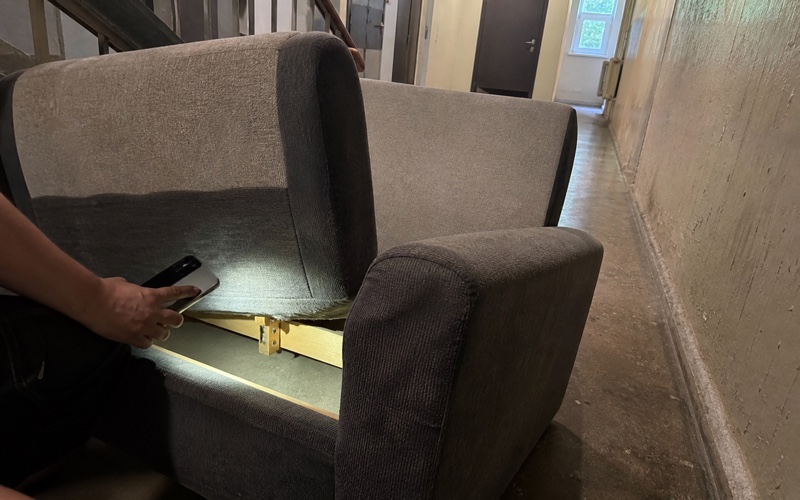
What to check before buying
The check takes a few minutes and is the only way to avoid a problem that later costs far more than the furniture did:
- Seams and edges — fold back the fabric along the whole perimeter, especially underneath.
- Under the cushions and behind the back — take out every removable element.
- Wooden frame joints — screw holes and gaps between boards.
- The underside — turn the piece over; there is usually a hessian cover, and bedbugs hide behind it.
Look for dark specks, translucent shed skins and live insects. Use a torch — a phone light is enough.
Riskiest items: mattresses, sofas, armchairs, bed frames, upholstered chairs. Least risky: metal and glass furniture, and solid wood items with no upholstery.
A specific warning about street finds
Furniture left beside the bins or in a stairwell has often been thrown out precisely because it had bedbugs or other pests in it.
This is the most common and most completely avoidable cause of an infestation: an apparently good free sofa is frequently the exact item the previous owner was trying to get rid of.
The same logic applies to items offered free online with an unusually urgent collection deadline, and to furniture left behind in a flat by departing tenants. Neither is automatically infested, but both deserve the full check rather than the benefit of the doubt.
How to buy second-hand safely
The second-hand market in Latvia is large and there is no need to avoid it entirely. A check before purchase is enough.
- 1
Inspect it at the seller's
, in daylight or with a torch, before any money changes hands.
- 2
Prefer hard furniture.
Solid wood, metal and glass carry far less risk than anything upholstered.
- 3
Ask why they are selling.
Moving abroad is a different answer from a vague one.
- 4
Unwrap it outside the flat
— on a balcony, in the stairwell, in a garage — and vacuum it before it comes in.
- 5
Keep it out of the bedroom for two weeks
if you can, and check it again in that time.
What to do if the item is already in the flat
If bites or signs have appeared after buying second-hand furniture, act quickly while the infestation is still confined to one item:
- Do not move the piece around other rooms — that is how you spread it.
- Do not throw it out immediately: in many cases the item can be saved with heat treatment inside a heat tent, which kills all stages including eggs without damaging the furniture.
- If you do dispose of it, wrap it in plastic before carrying it out, so insects do not fall into the stairwell and colonise your neighbours' flats.
If the infestation has already spread to the bed or other furniture, the room needs treating — see bedbug treatment. A treatment in a flat starts from €55.
Deciding whether to treat the item or the room
The practical question is usually how far it has got, and there is a reasonably clear way to judge it.
- Signs confined to the item itself — you find specks and shells in the sofa seams and nowhere else, and it has been in the flat only a few weeks. Heat treating that one item inside a tent is often enough, and it is the cheaper route.
- Signs beyond the item — bites in the morning, specks in the mattress seams, shells along a skirting board on the other side of the room. At that point treating the sofa alone will not resolve it, because the population has established elsewhere.
If you are unsure, describe what you have found and where in the enquiry form, and say when the furniture arrived. That combination usually settles which of the two situations it is before anyone travels, and we would rather do the smaller job where the smaller job is sufficient.
Book a pest control visit
Fill in the form — we reply within 5 minutes. We work weekends and handle urgent callouts.