
Wasp sting: what to do
For most people a wasp sting is painful but not dangerous. Serious risk exists in two situations: where the person is allergic to insect venom, or where there are many stings at once. Both need to be recognised quickly.
When emergency medical help is needed
Call emergency medical services (113 in Latvia) immediately if, after a sting, any of these appear:
- difficulty breathing, wheezing, or swelling of the throat or tongue;
- a rash or hives over a wide area of the body, not just around the sting;
- dizziness, fainting, or a rapidly racing heartbeat;
- nausea and vomiting together with any of the above;
- a sting in the mouth, throat or eye;
- many stings at once.
This may be anaphylactic shock, which develops very fast. Do not wait to see whether it settles.
If the person is known to be allergic and carries an adrenaline auto-injector, it should be used according to their doctor's instructions, and help should still be called even if the condition appears to improve — symptoms can return after an initial recovery.
In Latvia 113 is the medical emergency number; 112 also reaches the emergency services. Either will get help.
What to do in an ordinary case
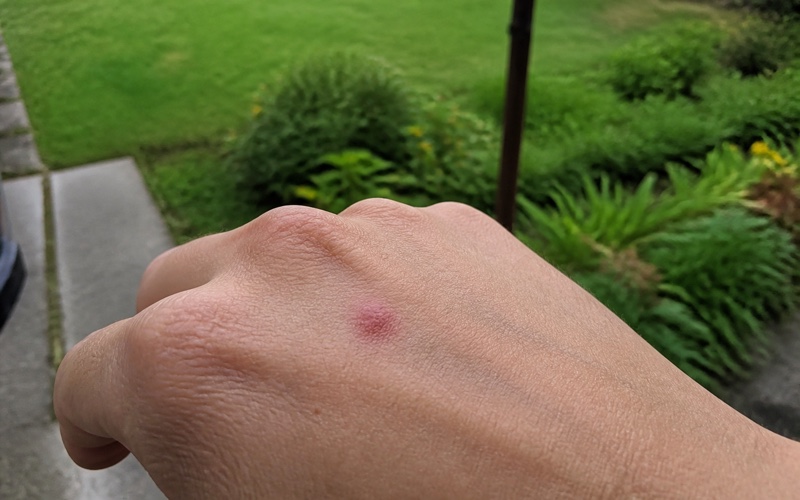
In most cases there is pain, redness and swelling at the site, which subsides over a few hours or days.
Unlike a bee, a wasp does not leave its sting behind, so there is nothing to look for and nothing to pull out. If a sting has been left in the skin, it was a bee.
Try not to scratch the site. If the symptoms intensify or the swelling spreads quickly, see a doctor.
We are not a medical service and we do not give specific treatment or medication advice. What we deal with is the nest.
Telling wasp, bee and hornet stings apart
| Wasp | Bee | Hornet | |
|---|---|---|---|
| Sting left in skin | No | Yes, usually | No |
| Can sting repeatedly | Yes | No | Yes |
| Pain | Sharp | Sharp | More intense, longer |
| Typical situation | Near food, drink, bins | Near flowers, stepped on | Near a nest, at dusk |
A hornet sting is more painful than a wasp sting but not, contrary to a widespread belief, proportionally more dangerous to a person without an allergy. The risk factors are the same: allergy and number of stings.
Why the wasp stung
Wasps do not attack without cause. A sting almost always happens in one of these situations: a nest is nearby and is perceived as threatened; the wasp has been accidentally crushed or trapped in clothing; or it is late summer, when the colony is seeking sugars and wasps become persistent around food and drink.
Repeated stings in the same place almost always mean there is a nest nearby. That is the main signal that the problem should be dealt with rather than tolerated.
Reducing the risk is mostly about the obvious things: keep drinks covered outdoors, check the rim of a glass before drinking, keep bins closed, and do not swat at a wasp near your face — the sudden movement is what provokes a sting.
Preventing a recurrence
The only way to stop repeated stings is to remove the nest. Doing it yourself is not advisable: a disturbed nest releases dozens of aggressive individuals within seconds, and the work is often at height.
A nest that is far from where people spend time will die off naturally at the first frosts. A nest by a doorway, a window, a balcony or a children's play area should be removed. Wasp nest removal starts from €60.
See wasp nest removal and hornet control. We handle urgent callouts and work at weekends, and we reply to enquiries within 5 minutes.
If you have to live alongside a nest until it can be dealt with, the practical measures are limited but real: keep the windows on that side closed or screened, keep children and pets away from the flight path, and do not block the entrance, which only makes the wasps look for another way in and out through the building fabric.
A nest is also worth dealing with earlier in the year than most people do. A nest the size of a golf ball in May holds a single queen; the same nest in August holds several thousand wasps. The removal is the same job at a fraction of the risk.
Book a pest control visit
Fill in the form — we reply within 5 minutes. We work weekends and handle urgent callouts.