
Pest control when you have pets
Having pets is not an obstacle to pest control, but it does require specific preparation steps. Sensitivity to insecticides varies enormously between species, and the most sensitive animals in a typical Riga flat are not the cat or the dog.
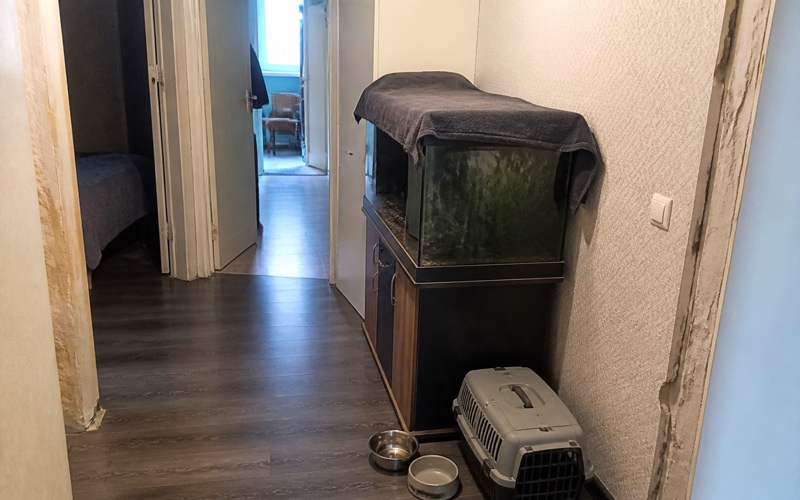
Aquariums and amphibians need the most attention
Fish, snails and amphibians are many times more sensitive to insecticides than mammals. The pyrethroids used in most treatments are highly toxic to aquatic organisms even at very low concentrations.
Before the treatment: cover the tank tightly with film or a lid, switch off the air pump and the external filter — both draw room air into the water — and do not open the lid until the room has been fully aired.
If the tank is large and cannot be safely covered, tell us in advance. In that case we choose a method that does not put it at risk, or treat the rooms selectively and leave that one alone.
Reptiles are handled the same way: seal the terrarium and switch off its ventilation for the duration.
Cats and dogs
- Out of the property during the treatment, for the same period as people — usually 2-4 hours.
- Remove bowls, toys and bedding, or wash them afterwards.
- Wipe the floor where the animal sleeps and eats before it comes back. Animals lick their paws, so accessible surfaces matter more for them than for you.
- Cats need extra attention. They climb onto surfaces and groom themselves intensively, so wiping down worktops, windowsills and shelves after a treatment matters more with a cat than with a dog.
If the problem is fleas, the animal has to be treated in parallel by a vet. Treat the flat alone and the fleas come back from the animal within days; treat the animal alone and they come back from the carpet. See flea treatment.
Birds, rodents and reptiles
- Birds are extremely sensitive to airborne substances because of how their respiratory system is built. A cage has to leave the property for the treatment and the airing period — moving it into another room of the same flat is not enough, because air moves between rooms.
- Rodents and rabbits — take the cage out of the rooms being treated and change the bedding when you come back.
- Reptiles — the terrarium is sealed and its ventilation switched off, as with an aquarium. Heat lamps and pumps go off for the duration.
If you are not sure whether your particular animal counts as unusually sensitive, say so in the enquiry. It is easier for us to plan around it than to find out on the day.
Why some species are more sensitive
The differences are not arbitrary, and knowing why helps make sense of the preparation.
- Fish and amphibians absorb substances directly across gills and skin from the water they live in, with no way to avoid the exposure. Concentrations that are harmless in air become significant once dissolved.
- Birds have air sacs as well as lungs, which makes their gas exchange far more efficient — and therefore far more efficient at taking in anything airborne.
- Cats metabolise some compounds more slowly than dogs and groom far more, so they take in more via the coat.
- Dogs are the least sensitive of the common pets, which is not a reason to skip the precautions.
Before the animal comes back
- 1
Air the rooms
for 30-60 minutes with a cross-draught before the animal returns.
- 2
Wipe the floor
in the feeding and sleeping areas, and any low surface the animal uses.
- 3
Wash or replace bowls
and put down fresh water.
- 4
Wash the bedding
at the highest temperature the fabric allows, especially in a flea case.
- 5
Leave the skirting boards and gaps alone.
That is where the residual layer is doing its work, and it is not where the animal spends its time.
Tell us in the enquiry form what animals are in the property and whether there is an aquarium or terrarium. It affects both the method and the preparation instructions we give you.
When the pest is the reason the pet is suffering
Sometimes the animal is not a complication to work around but the reason for the call. Two situations come up constantly in Riga flats.
- Fleas. The animal is bitten, scratches, loses fur in patches and is visibly miserable — and the owner assumes the problem is on the animal. In reality only a small part of the population lives on the pet. The great majority is in the carpet, the sofa, the pet bed and the cracks in the floor, as eggs, larvae and pupae. That is why vet treatment alone gives a few good days and then the itching returns. See flea treatment.
- Bedbugs. Bedbugs prefer people, but where a dog sleeps on or beside the bed they will feed on it too. A dog with unexplained bites and an owner with bites in the morning usually points to one shared cause rather than two.
In both cases treating the property and the animal in parallel is not an optional extra. It is the only sequence that ends the cycle rather than pausing it.
Book a pest control visit
Fill in the form — we reply within 5 minutes. We work weekends and handle urgent callouts.