
Gel baits for cockroaches
Gel bait is the modern standard against cockroaches. The product is applied in small dots near harbourage, and the insects carry it back to the nest themselves, killing individuals the treatment never touched directly.
The cascade effect
A cockroach eats a small amount of bait and returns to its harbourage. There the active ingredient passes to the rest of the colony through droppings, regurgitation and the bodies of dead insects, which cockroaches feed on.
This chain reaction means that insects which never touched the bait die too, including nymphs deep inside the structure. That is precisely why gel eliminates a colony rather than just the cockroaches you can see.
Why gel beats spraying
Spraying aerosols at cockroaches does the opposite of what you want: it kills some of the visible insects and scatters the rest, which flee deeper into the structure and into neighbouring flats. It is common for a problem to get bigger after a DIY spray.
Spraying also requires clearing the rooms and being out for several hours. Gel requires neither.
| Gel bait | Spraying | |
|---|---|---|
| Do you have to leave? | No | 2-4 h |
| Empty the cupboards? | No | Yes |
| Effect on the colony | Yes, cascade effect | Direct contact only |
| Scatters the colony | No | Likely |
Where the bait goes
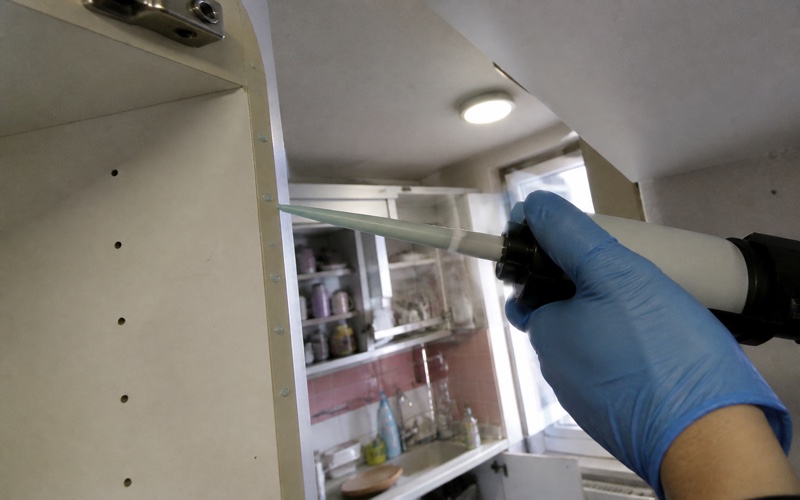
Bait is applied in dots where cockroaches travel and hide, but out of reach of children and pets: inside cupboard corners, behind and under the fridge, behind the cooker, under the sink, around pipe entries and near cupboard hinges.
Important after the treatment: do not wash the bait dots off or spray them with cleaning products — that stops the method working. Postpone a deep clean of the kitchen for a couple of weeks.
Why the bait points must be left alone
This is the most common mistake after a gel treatment, and it cancels the effect entirely.
Gel works for as long as it is available to the cockroaches. If the dots are washed off with detergent or sprayed with an aerosol, the delivery of the product into the nest stops and the colony survives.
In practice: carry on with everyday cleaning as normal, but put off a deep clean for two to three weeks and do not touch the bait points at all. If the dots have dried out or been eaten, that is a good sign rather than a problem, and we refresh them if needed.
How fast you see results, and where gel does not fit
The number of visible cockroaches usually starts dropping sharply within 3 to 7 days. Full elimination of the colony, including individuals hatching from egg cases, takes 2 to 4 weeks. In the first few days you may see more cockroaches than usual, because they come out of hiding for the bait — that is normal and a good sign.
The honest limits: in a very heavy infestation, gel alone may not be enough and we combine it with a residual treatment of gaps and entry routes. If the room has recently been sprayed with a repellent aerosol, cockroaches avoid the treated areas including the bait. If there is a lot of accessible food, the bait has to compete with it. And gel does not work against bedbugs at all, because they feed on blood, not bait.
Where exactly the bait points go
Placement is most of the method. The same product placed badly does nothing at all, because cockroaches never encounter it.
- Inside cupboard corners, particularly upper corners and around hinges, where cockroaches shelter during the day.
- Behind and underneath the fridge, including the compressor recess, which is warm and undisturbed.
- Behind and beside the cooker, and in the gaps where units meet the wall.
- Under the sink, around the waste pipe and the shut-off valves.
- Around pipe and cable entries, which are also the routes in from neighbouring flats.
- Along the tops of wall units and inside the plinth beneath base units.
Note what these have in common: all are out of sight, out of reach of children and pets, close to harbourage and near a water source. Bait applied to an open worktop is both useless and inappropriate.
Which insects gel works on
Gel baits are species-specific, and that matters when comparing what worked for somebody else.
- Cockroaches. The primary use, and the method of choice in a flat, because nothing has to be cleared or vacated.
- Ants. A different bait formulation on the same principle: workers carry it back and it reaches the queen and the brood. Spraying an ant trail kills workers and leaves the nest producing more, which is why trails reappear within days.
- Not bedbugs. They feed on blood, not bait, so no gel of any kind affects them. If somebody has offered you gel for bedbugs, that is a reason to ask more questions.
- Not flies, moths, wasps or silverfish, each of which needs a different approach entirely — see all methods.
Book a pest control visit
Fill in the form — we reply within 5 minutes. We work weekends and handle urgent callouts.