
Flea bites: signs and what to do
Flea bites are one of the most common complaints, and they are fairly reliably identified by their position: almost always on the feet, ankles and lower legs. The reason is simple — fleas jump from the floor and do not get very far.
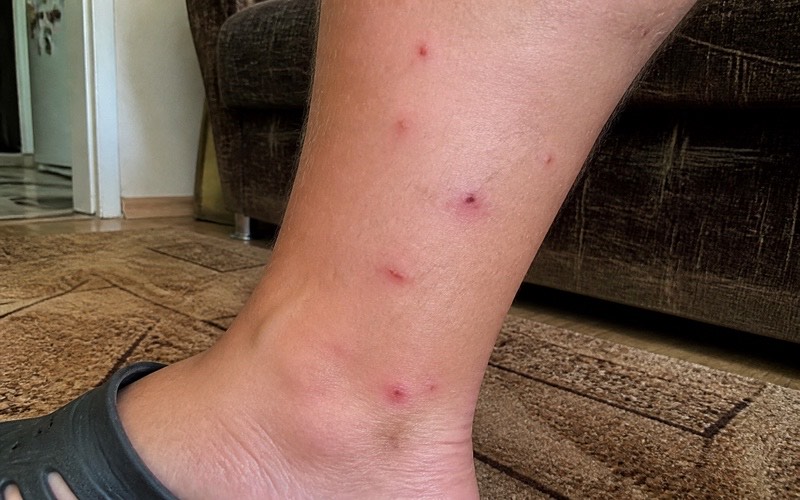
What a flea bite looks like
A small red spot with a darker point in the centre, where the flea pierced the skin. A lighter halo of redness often forms around it.
The bites are usually several close together or in an irregular group, because a flea bites repeatedly while searching for a blood vessel. The itch is pronounced and starts almost immediately — unlike bedbug bites, which are only noticed later.
On the lower leg they rarely go higher than about knee level, and that height limit is itself one of the more useful clues.
Telling them apart from other insect bites
| Fleas | Bedbugs | Mosquitoes | |
|---|---|---|---|
| Where on the body | Feet, ankles, lower legs | Exposed skin in bed: arms, neck, shoulders | Anywhere uncovered |
| Arrangement | Grouped, irregular | Often in a line | Separate, scattered |
| When noticed | Immediately, itch is instant | In the morning after sleep | Immediately |
| Appearance | Small central point | Larger, swollen spot | A weal that fades quickly |
If the bites are on the legs and there is a cat or a dog in the home, they are almost certainly fleas. If they appear in the morning on arms and shoulders, see bedbug bites.
Why the itch lasts so long
When a flea bites it injects saliva that prevents the blood clotting. The body reacts to those proteins by releasing histamine, which is what produces the itching, redness and slight swelling.
The reaction is individual and can persist for several days after the bite itself. Scratching prolongs it, because the mechanical irritation keeps the histamine response going.
Some people develop increasing sensitivity over repeated exposure, so bites that were barely noticeable in the first week become markedly worse in the third. That is a sign the population is established, not that the fleas have changed.
Reaction strength also varies between people in the same household, and it varies a great deal. Children often react more strongly than adults, and a few people develop small blisters rather than simple spots.
That variation explains a common situation: one family member has bites and the others do not, which raises doubts about whether fleas are involved at all.
There are two ordinary explanations. The first is skin reaction — as with bedbugs, sensitivity varies, and someone with no reaction can be bitten just as often. The second is genuine preference: fleas do respond to differences in body temperature, carbon dioxide output and skin chemistry, so within a household some people really are bitten more.
Neither changes what has to be done. The population is in the room, not on one person.
There is a related pattern worth knowing about in flats that have been empty for a while. Flea pupae can lie dormant for months and are triggered to hatch by vibration, warmth and carbon dioxide — that is, by someone walking in. A new tenant bitten heavily in the first week of a previously empty flat is a classic case, and it says nothing about their own cleanliness. See pests in a rented flat.
Confirming it really is fleas
Bites alone are not proof — an allergic reaction or other insects can look similar. A few practical checks help.
- White sock test. Put on white socks, walk slowly around the carpeted areas for a few minutes, then look. Fleas jump on and are visible against white.
- Flea dirt on the animal. Comb the pet over damp white paper. Dark specks that turn reddish-brown when wet are digested blood.
- The pet's behaviour. Persistent scratching, biting at the base of the tail, patchy fur loss.
- Where the bites are. Consistently below knee level is a strong indicator.
What to do about the bites themselves
The main advice is not to scratch. Scratched areas can become infected, and it is the infection rather than the bite that causes the more serious problems.
If the itching is severe, the bites spread, a rash appears over a wider area, or there is fever or swelling that does not subside, see a doctor.
We are not a medical service and we do not give advice on treatment or medication. What we can do is deal with the cause in the property.
And that is the point: bites are a symptom. While there is a flea population in the rooms, new bites will keep coming regardless of how the skin is cared for.
What the property needs
If bites keep recurring, there is a population in the rooms — and the adult fleas you might see are only a small part of it. The great majority are larvae and pupae in carpets, upholstered furniture and the animal's bedding.
If there is an animal in the home, the rooms must be treated at the same time as the animal is treated by a vet. Treat only one and the fleas return within days. See flea treatment.
If there is no animal, the fleas most likely came in from the stairwell or basement, or were left behind by previous occupants who had a pet. That happens more often than people expect in rented flats in Riga.
Before the treatment, thorough vacuuming genuinely helps: it removes a share of the eggs and larvae outright, and the vibration brings dormant pupae out where the product can reach them. Vacuum the carpets, the gaps between floorboards, under the furniture and the pet's sleeping area, and put the bag straight into a bin outside the flat.
Honestly about what treatment can and cannot do: it clears the population in the rooms. If the animal has not been treated in parallel by a vet, or if fleas keep arriving from a communal basement, they will come back — and no product applied indoors changes either of those.
Book a pest control visit
Fill in the form — we reply within 5 minutes. We work weekends and handle urgent callouts.