
Ant control at a house
At a house, ants almost never nest indoors. They live outside — under the deck, paving or foundations — and come in only for food. So treating the kitchen alone is treating the symptom.
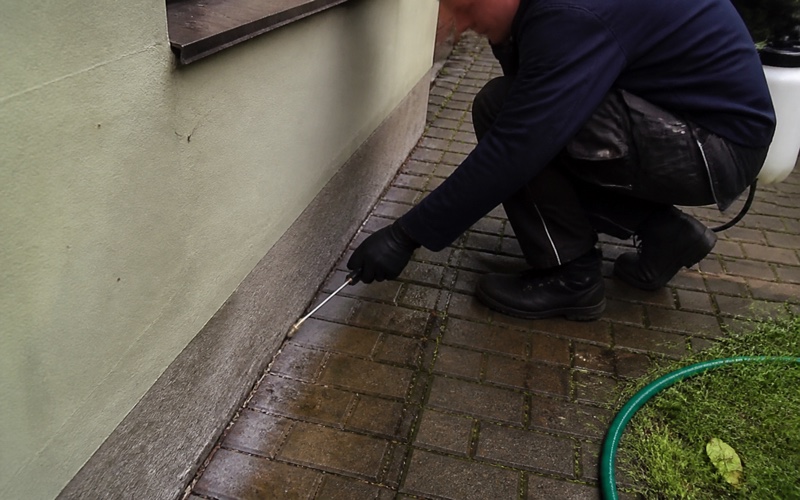
Where the nest is at a house
Typical locations: under deck boards and foundations, in paving and slab joints, under stones and plant pots by the house, in stumps and rotting timber, in damaged insulation, and under the path running along the building.
The nest can often be found by following the ant trail in the opposite direction — from where they come in, outwards. Ants move along a stable pheromone trail, so the route is consistent and easy to observe.
Why treating only the kitchen does not work
The ants you see on the worktop are foragers — roughly 5–10% of the colony. Killing them leaves the nest untouched, and within days it sends out more.
Worse, spraying a trail with aerosol can cause the colony to split, so one nest becomes several. See also ant control.
A three-level approach at a house
- 1
The nest.
If found, it is treated directly — the fastest route to a result.
- 2
Bait indoors.
If the nest is not accessible, bait is placed on the trails; the ants carry the product to the nest themselves.
- 3
The perimeter.
Treating the building's external perimeter — foundation zone, plinth, door and window reveals — forms a barrier against new colonies.
How to find the nest in the garden yourself
Finding the nest speeds up the result, and you can often do it before we arrive.
- Method: find the ant trail indoors and follow it backwards — from where they come in, outwards. Ants move along a stable pheromone trail, so the route is consistent.
- Best time: early morning or evening, when activity is highest but it is not hot.
- Where the trail usually ends: in paving or slab joints, under deck boards, at the foundations, under a stone or plant pot, in a stump or rotting timber, or under the path along the house.
- Signs of a nest: small heaps of fine soil, intense activity at one point, damp soil with tunnels if you lift a stone or board.
If you find it, do not treat it yourself with aerosol — that can split the colony so one nest becomes several. Just tell us the location in the enquiry.
What you can do yourself
- Seal gaps at the foundations, window reveals and pipe entries.
- Move the log pile and compost away from the wall — both are favourite nest sites.
- Deal with damp at the foundations: sort out gutters and rainwater run-off.
- Do not leave sweet food or pet food uncovered — it is the main reason ants come indoors at all.
Book: ant control at a house
Fill in the form — we reply within 5 minutes and quote a price before any work starts.