
Pest control in care homes
In care settings the planning is governed by the vulnerability of the residents: elderly people, limited mobility and continuous presence in the rooms. A standard approach does not fit.
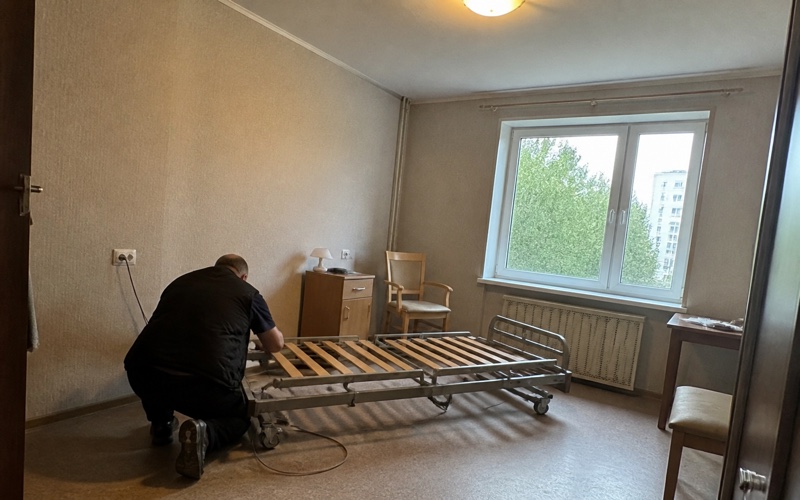
Why this needs a different approach
In care settings residents often cannot move independently, and clearing rooms for several hours is not simple to organise. On top of that, elderly people and people with chronic respiratory conditions require a stricter standard from any product used.
So the treatment is carried out zone by zone: residents are moved to rooms that are either already treated or not yet due, and each zone is returned to use only after full airing and surface cleaning.
How zones are planned
- 1
Survey and mapping.
We agree which rooms are treated in which order, and where residents go during each stage.
- 2
Preparation of the zone.
Personal belongings, medication and textiles are removed or sealed; staff handle anything resident-specific.
- 3
Treatment.
Applied to specific harbourage points rather than sprayed broadly, with heat used where textiles and beds are the target.
- 4
Airing and cleaning.
Extended airing, then wet-cleaning of every surface within reach.
- 5
Return to use.
Only then do residents come back, and we move to the next zone.
Bedbugs in care settings
Bedbugs are a particular issue here: many beds, a lot of textiles and soft furniture, and constant movement of people and laundry between rooms.
Elderly residents often react weakly to bites, or do not mention them, so an infestation is typically noticed late — frequently by a staff member or a visiting relative rather than the resident. By then it usually involves more than one room.
Heat treatment is especially useful in this setting: it uses no chemicals and kills bedbugs in mattresses and soft furniture at every life stage, including the eggs.
Schedule, monitoring and documentation
For care settings we recommend regular preventive treatment with monitoring rather than reacting to a problem already found. Reacting is slower, more disruptive and more distressing for residents than a scheduled inspection.
Regular inspection of beds and soft furnishings by staff, with a simple record of what was checked and when, catches most introductions early. For sites on regular servicing we prepare documentation of the work carried out and the monitoring data.
Cost is quoted after a survey: the number of rooms, the zoning requirements and the working hours all shape it.
What staff can check between visits
The single most valuable thing in a care setting is early detection, and staff are better placed to achieve it than any scheduled visit.
- Mattress seams and the bed frame joints, checked when linen is changed. This is where bedbugs are found first, long before anything is visible in the room.
- Soft chairs beside beds, particularly the underside and the seams.
- Unexplained bites on residents, recorded with the room number and the date rather than treated as a skin complaint.
- Kitchen and servery warm zones, behind and under equipment, for cockroach activity.
- Damp washrooms and laundry areas, for silverfish and drain flies.
A short written record of what was checked and when is worth more than an occasional thorough inspection, because it shows change over time.
Working around residents
The practical constraint in a care setting is not the treatment but the movement of people, and it needs planning with the staff who know the residents.
We agree the sequence in advance: which rooms are treated on which day, where residents go during the work, and how long each zone needs before it is signed back into use. Where residents cannot easily be moved at all, heat treatment of individual items and targeted work in a single room is usually preferable to a broader chemical treatment.
Medication, personal belongings and anything resident-specific is handled by staff rather than by us. We ask that it is removed or sealed before we arrive, because it is not our place to sort through a resident’s possessions and because staff know what matters to whom.
Airing periods here are longer than the standard 2 to 4 hours, and every accessible surface is wet-cleaned before residents return.
Book a pest control visit
Fill in the form — we reply within 5 minutes. We work weekends and handle urgent callouts.