
Pest control in an office
In an office the result is only half the job. The other half is how it is achieved: without interrupting work, without drawing attention, and without awkward questions from staff or clients.
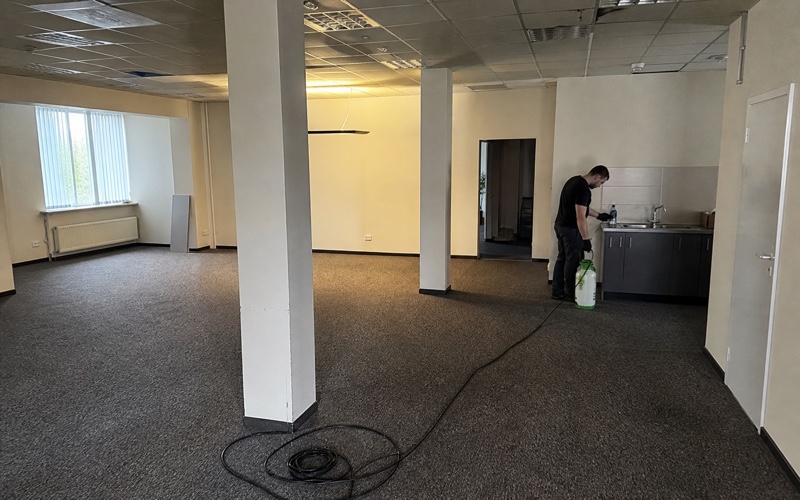
Treatment outside working hours
The standard arrangement for an office is an evening treatment after everyone has left, or work at the weekend. The product dries overnight, the rooms are aired, and the office is ready in the morning.
That means zero downtime, and in practice most staff never notice the treatment happened at all. We work weekends, so that does not restrict availability.
Where the problems start
Contrary to the usual assumption, an office is an attractive environment for insects: warm, stable and with food constantly present.
The typical hotspots are the kitchenette and coffee area, bins, the back and drip tray of the fridge, snacks kept in desk drawers, the warmth of server rooms, and the ventilation system, through which insects arrive from other floors of the building.
In buildings with shared ventilation and several tenants, the source is often another floor or the neighbouring unit — which means the building manager has to be involved for the fix to hold.
What staff need to do
If the treatment happens after hours, staff need to do very little. The preparation is minimal: clear food and drinks off the desks, cover or move computer equipment where we are treating the desk surface itself, and make sure we have access to the kitchenette and the bin area.
If anyone in the office has a known allergy or asthma, tell us. We adjust the method and plan a longer airing period rather than finding out afterwards.
Why the problem keeps coming back
In a multi-tenant building, treating one office often gives only a temporary result, for the same reason as in a block of flats: insects move between floors and units through the ventilation system, cable runs and service ducts.
If the source is elsewhere in the building, your office stays open to reinfestation no matter how well it is treated. The long-term answer is a conversation with the building manager about the shared areas and the ventilation system, and we can write up what we found so you have something concrete to submit.
Discretion, and when regular servicing pays
We work without branded vehicles and without lettering on clothing. If the office has a client-facing area or reputational sensitivities, we take that into account when planning the visit.
Regular servicing becomes the better option in three situations: when the office sits in a large multi-tenant building, when there is a heavily used kitchen and eating area, and when clients are received on site. In all three, a problem noticed by monitoring costs far less than one noticed by a client — see preventive treatment.
For commercial premises we quote after a survey, because floor area, number of zones and risk level vary too much to publish a single figure.
What sets the price and the plan
Office work is quoted after a survey, and four things shape both the figure and the schedule.
- Floor area and the number of separate zones. An open-plan floor with one kitchenette is a very different job from six units on two levels.
- Risk level. A heavily used kitchen and eating area, or a client-facing reception with upholstered seating, raises the scope.
- Working hours. Evening, night and weekend work is planned separately, though for most offices it is the default rather than an exception.
- Documentation and regularity. Whether a monitoring plan and an inspection register are needed, and whether the work is one-off or scheduled. Per-visit cost on a schedule is lower than a one-off call-out.
Tell us the floor area, the number of kitchens and whether the building has shared ventilation with other tenants. Those three facts alone let us judge the scope before the survey.
Book a pest control visit
Fill in the form — we reply within 5 minutes. We work weekends and handle urgent callouts.