
Wasp nest in a house
At a house, wasps almost always nest in the building structure rather than freely in a tree. That makes the problem structural as well as biological: you have to work out exactly where the nest is and how to reach it.
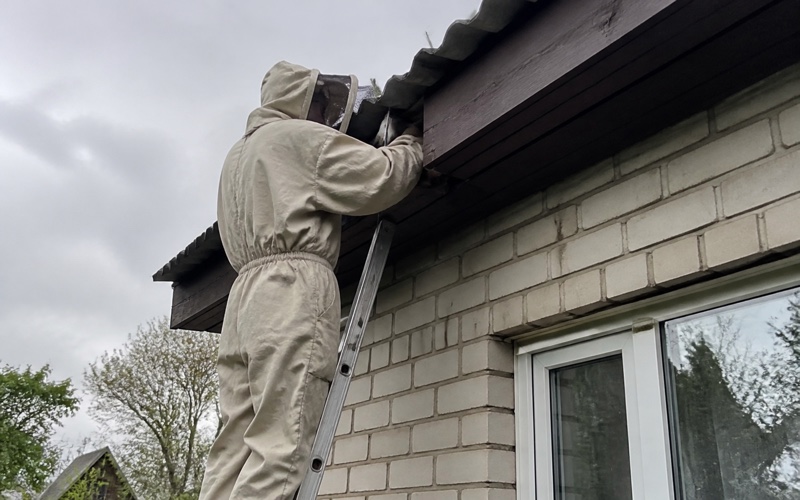
Where nests form at a house
Wasps choose a dry, sheltered cavity with a small entrance. A house offers plenty:
- The loft — the most common location; the nest hangs from rafters or roof lining.
- Under the fascia and eaves — access through a gap between cladding and wall.
- In a wall cavity — between cladding and insulation; the entrance is often a gap by a window reveal or a vent.
- Under a deck, and in sheds, garages and log stores.
- In the ground — ground-nesting wasps use abandoned rodent burrows in the lawn.
The location can often be worked out by watching where wasps consistently fly in and out — that is the most reliable indicator.
Why a wall cavity is a special case
A nest in a wall cavity is the most common and the most awkward case. It cannot be seen, and the only accessible point is the entrance hole.
The product is introduced through that hole, and the wasps passing through destroy the colony. The entrance must not be sealed immediately — sealing it before the colony is dead makes the wasps look for another way out, and they can end up inside the living space through ceiling or wall gaps.
Sealing is done only after the colony has been destroyed — usually a few days later.
Working at height
Nests under roof edges and in lofts mean working from a ladder or at height. That is the main reason DIY attempts at a house end in an injury rather than a sting: panic on a ladder is more dangerous than the stings themselves.
We work in a full protective suit, usually in the evening or early morning when almost the whole colony is in the nest.
Preventing it next season
Wasps do not reuse an old nest, but they often choose the same location. After removal it is worth sealing entry gaps, securing vent screens and checking roof cladding joints.
In summer houses and seasonally empty buildings the problem recurs more often — see summer house pest control.
What it costs and how long it takes
Wasp nest removal at a house starts from EUR 60. The price is set mainly not by the size of the nest but by how difficult it is to reach: a nest low on a shed wall is a simple job, a nest in a wall cavity at third-floor height is not.
The work itself usually takes 20–60 minutes. We carry it out in the evening or early morning, when almost the whole colony is in the nest, which gives a more complete result.
Most of the wasps die within a few hours. Individuals that were away from the nest at the time may return for a day or two, so it usually goes quiet on the second or third day.
Book: wasp nest in a house
Fill in the form — we reply within 5 minutes and quote a price before any work starts.