
Bedbugs in a hotel — discreet treatment
In a hotel, bedbugs are a question of time and reputation at once: how long the room is unsellable, and whether the guest posts a review. Both are affected only by acting fast and choosing the right method.
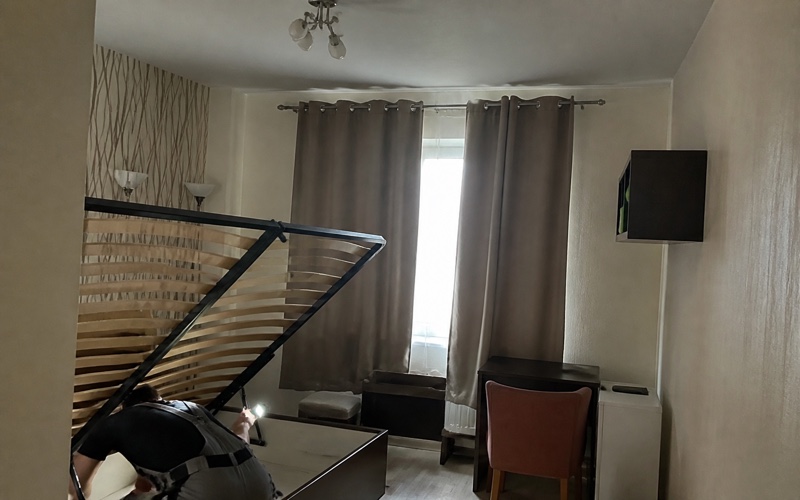
Why bedbugs in a hotel are not a hygiene issue
Bedbugs arrive in a hotel with guest luggage — the main route they spread worldwide. In a property with high turnover and international guests this is a statistical inevitability, not an indicator of cleanliness.
What matters in practice is not preventing introduction, which is impossible, but detecting it early, before the infestation spreads to adjoining rooms.
Adjoining rooms must always be checked
Bedbugs travel through wall voids, electrical conduits and skirting boards. By the time a guest complains about one room, the infestation has often already reached neighbouring spaces.
The standard approach is to treat the affected room and check at least both adjoining rooms, plus the rooms directly above and below. That costs considerably less than treating a whole floor a month later.
Why heat treatment suits a hotel
The main cost to a hotel is not the treatment but room downtime. Heat treatment is economically better here even though it costs more:
- The room is usable as soon as it has cooled — no airing period.
- No chemical smell for a guest to notice and comment on.
- One treatment is often enough, because heat kills the eggs — no need to take the room out of sale again two weeks later.
- Mattresses and soft furnishings can be treated inside a heat tent without disrupting the rest of the floor.
What to do with the guest's belongings
If a guest has reported bites, how you handle their luggage is both a practical and a reputational matter — and handling it well often decides whether the incident becomes a public review.
- Offer textile treatment. The guest's clothing can be washed at 60 °C or tumble-dried on high for 30 minutes, which reliably kills every life stage.
- Do not move the guest to an adjoining room — if bedbugs have spread, it may be affected. Move them to a different floor.
- Be straightforward. In practice guests respond far better to fast, professional action than to an attempt to deny the problem.
Prevention — the only way to avoid a review
Reacting after a guest complains always means the reputational risk has already materialised. For high-turnover properties we recommend regular room checks with monitoring, focused on bed frames, mattress seams and headboards.
Mattress and pillow encasements with a zip make those checks far easier and stop bedbugs colonising the seams in the first place.
Book: bedbugs in a hotel — discreet treatment
Fill in the form — we reply within 5 minutes and quote a price before any work starts.